
The following is considered for use as informational purposes only. Do not use this information as clinical advice. Do not use this information as veterinary advice. Tomaskas Ltd takes no responsibility for you using the information on this page in any way to treat any animal for any purpose. This information and spreadsheet is used at your own risk.
Some exciting news has hit the UK. Very recently, the drug Afoxolaner has become available for use without a veterinary prescription in the UK.
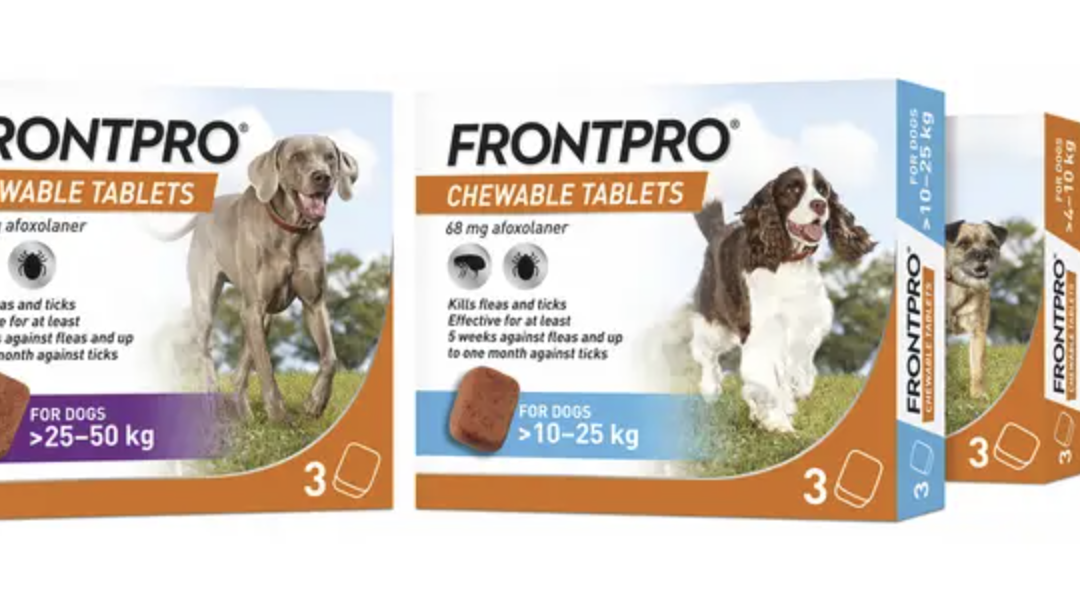
The brand name is FRONTPRO®, and it’s from Boehringer Ingelheim Vetmedica Gmbh, the same company that brought us FRONTLINE® (Fipronil). FRONTPRO® comes in the form of small chews which would normally be given to a dog to treat some fleas and mites. It comes in 4 sizes or doses, and doesn’t require you to see a vet before making a purchase.
Afoxolaner, under another brand name called NexGard®, has been shown to safely treat mites in snakes in studies (references at bottom). And it is now fairly regularly used to treat snakes in captivity for an infestation of the dreaded snake mite (Ophionyssus natricis) which plagues collections, shops, breeding facilities, zoos, holding pens, quarantine bays, customs offices, and many homes in the UK.
When using Afoxolaner, general practice is to take one of the ‘chews’, and dilute it with water to create a solution which can then be injected/forced into the body cavity or dermis of a prey item such as a frozen/thawed rodent. When treated this way, there has shown to be a total eradication of mites within just a few days, with zero mites even a month later.
Ok, so why not use Fipronil, Mite-Off, Ivermectin, Permethrin, Cypermethrin, etc?
These methods have shown to work, there is no doubt about it. But I implore you to consider some different aspects of the situation. And I urge you not to just hold the position of “it has worked for me for ages so I’ll stick to what I know”, something I’ve covered passionately in the past.
Firstly, the use of any topical or aerosolised concoction requires handling the snake in some way, often more than once in the space of a week. This, whether you like it or not, is very often stress-inducing for a snake.
That goes without even mentioning the added stress to an already aggravated ‘biter’ snake, a large constrictor, or a venomous snake – all of which require a lot of extra protocols and safety considerations just to handle the animal in the first place, before we then have to force it to be rubbed up and down with chemicals.
Secondly, topical treatments are toxic to the environment. If your snake is in a room where other animals are kept (such as invertebrates) then you put those other animals at risk of accidental secondary exposure. That’s without considering your own health on the matter – aerosols aren’t great at the best of times as they are, never mind when they contain insecticides on top.
Third, it’s an absolute necessity that your animal is provided with clean fresh drinking water. If you use a topical treatment, it is considered standard practice to remove access to water for 24-48 hours to avoid contamination of the topical insecticide into the water. This is a raging red flag where welfare is concerned. An animal infested with mites is prone to dehydration, the last thing we want to do is take away their water! And what about species in which they otherwise generally live in or near significant bodies of water, such as many boas? For those animals, we’d have to restrict access to natural behaviours just to treat the mites.
Now consider the protocol with Afoxolaner: You put the drug in a non-toxic dose into a food item and then feed as normal. That’s it. No handling, no added safety protocols, no removing of water. The only major risk is that you get the dosage wrong….
So how would a person dose it?
In studies, dosage rates of 2mg Afoxolaner to 1kg Body Weight and 2.5mg Afoxolaner to 1kg Body Weight are used. In practice, some drop this down to 1.5mg or even less of Afoxolaner to 1kg Body Weight.
To make things as easy as possible for informational purposes, I’ve made a set of ‘calculators’. They are a Excel Spreadsheets, and work to do the calculations with just a little information from the user.
Snakes 200g and above
For snakes 200g or above, you can use either spreadsheet, but the ‘pill only’ sheet may produce instructions that would be easier to follow.
This sheet makes reference to the requirement of precision scales (the sort that measure down to 0.01g), but it would also be useful to have a precision blade such as a scalpel to hand. All a person needs is the weight of the snake, the ‘chew’ size (or dosage), and then to weigh one of the chews on the precision scales.
With those details, the calculator then works out and provides information on how small to cut up the pill, and how much Afoxolaner to put into a feeder rodent in order to meet the dosage of 2mg Afoxolaner to 1kg Body Weight.
Snakes under 200g
For smaller animals, it would be more practical to make a solution out of water and Afoxolaner, and then dose that accordingly. The second calculator works this out.
All a person needs to do is tell the sheet the weight of a snake, the ‘chew’ size (or dosage), and how much water they might use as for dilution purposes to make a slurry or solution.
With those details, the calculator then works out and provides information on how much of that water/Afoxolaner mixture a person could put into a feeder rodent in order to meet the dosage of 2mg Afoxolaner to 1kg Body Weight through a syringe.
Given practicalities and logistics, the sheet also provides information on an ideal amount to inject into a feeder rodent in order to minimise issues (it wouldn’t be practical, for example, to inject 50ml of solution into a pinky mouse. Equally, it wouldn’t be practical to cut a chew up into 20 pieces to get the dosage down).
The calculator tries to keep the amount of solution injected at a reasonable practical level – such as close to 5ml, and it measures chews in increments of 0.5 (half a chew) for practical reasons.
Where do I download the calculators?
Here is a download link for the ‘pill only’ calculator, better for larger snakes: CLICK HERE (or the below image).

Here is a download link for the ‘Water Dilution” calculator, generally for smaller snakes: CLICK HERE (or the below image).
I can’t stress this enough, these file are NOT medical advice. They are not approved by any veterinarians and are not a guaranteed method to eradicate your animal from mites. If you plan on treating your animal, speak to a veterinarian.
How can I help?
It’s important to remember that the files may contain bugs (no pun intended).
A known bug, for example, is if you input a weight of a snake as 0g, this may cause formatting errors. This isn’t necessarily a difficult fix, but is time consuming and I didn’t consider it important for the sake of the document as it would be unrealistic (aka physically impossible) for a snake to weigh 0g.
If you want to have a play with the sheets, and have any bug fixes then please do let me know.
References:
Mendoza-Roldan, J., Napoli, E., Perles, L. et al. Afoxolaner (NexGard®) in pet snakes for the treatment and control of Ophionyssus natricis (Mesostigmata: Macronyssidae). Parasites Vectors 16, 6 (2023).
https://doi.org/10.1186/s13071-022-05611-1
Fuantos Gámez BA et al. Successful treatment of Ophionyssus natricis with afoxolaner in two Burmese pythons (Python molurus bivittatus). Vet Dermatol. 2020 Dec;31(6):496-e131. Epub 2020 Oct 5. PMID: 33016515. https://doi.org/10.1111/vde.12898
This page is considered for use as informational purposes only. Do not use this information as clinical advice. Do not use this information as veterinary advice. Tomaskas Ltd takes no responsibility for you using the information on this page in any way to treat any animal for any purpose. This information and spreadsheet is used at your own risk.