

A PDF version of this article can be downloaded by clicking here.
Introduction – the confusions seen and setting a standard.
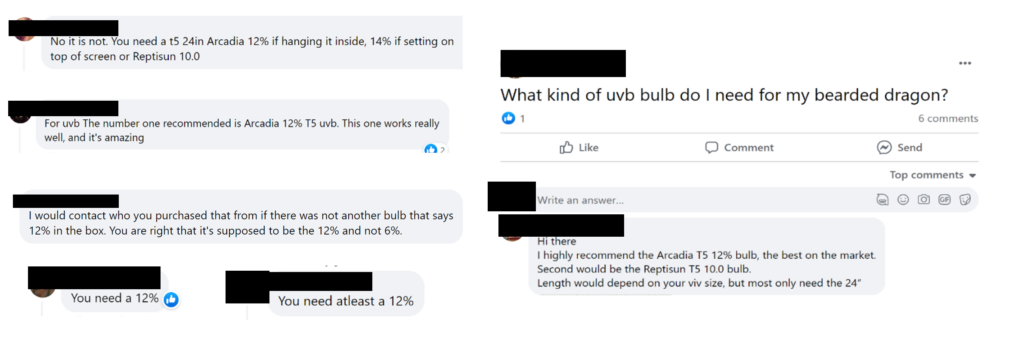
I often see recommendations banded around on forums, with things like “you need a 12% lamp for a bearded dragon”, or “that tortoise needs a 6% lamp because it comes from a forest”.
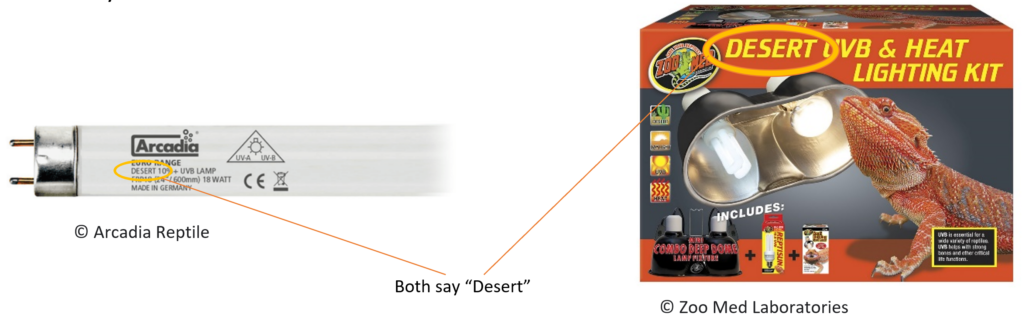
It’s easy to see how this happens. Reptile brands market their lamps at “forest” animals and “desert” animals. This is in no way an attack on the reptile brands. It’s a difficult job trying to explain reptile lighting in a 2-hour presentation – never mind putting all the information onto a single box! Not only that, it’s a box that a large proportion of people don’t see, as they buy their lamp online without looking at the packaging at all. I don’t envy the reptile brands here, it’s not easy!
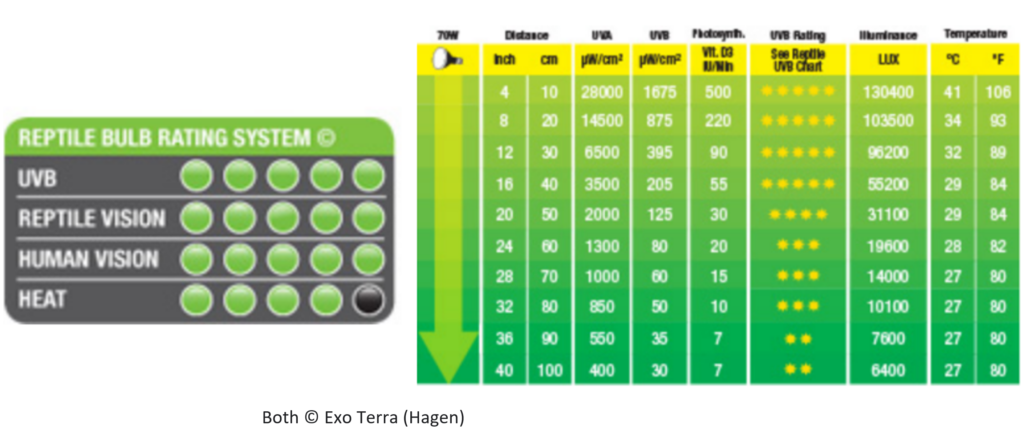
Most brands have implemented some kind of system to help get as much information to the consumer as possible. But there is hardly a standard across the hobby. For example, Exo Terra uses a “star-based” system to rate their lamps. But just by looking at the box, this implies that more stars equals “better quality” UVB…but this isn’t the case.
To make matters more confusing, even the scientific community varies in its standard. Some scientific papers measure UVB in units of microwatts per centimetre squared (µW/cm²), whilst others prefer to refer to a light source’s Ultraviolet Index reading (UVI). Many lamp manufacturers use these units too – but there’s no standards there either! Many European and Chinese brands tend to prefer µW/cm², whilst many UK brands or US brands will use UVI.
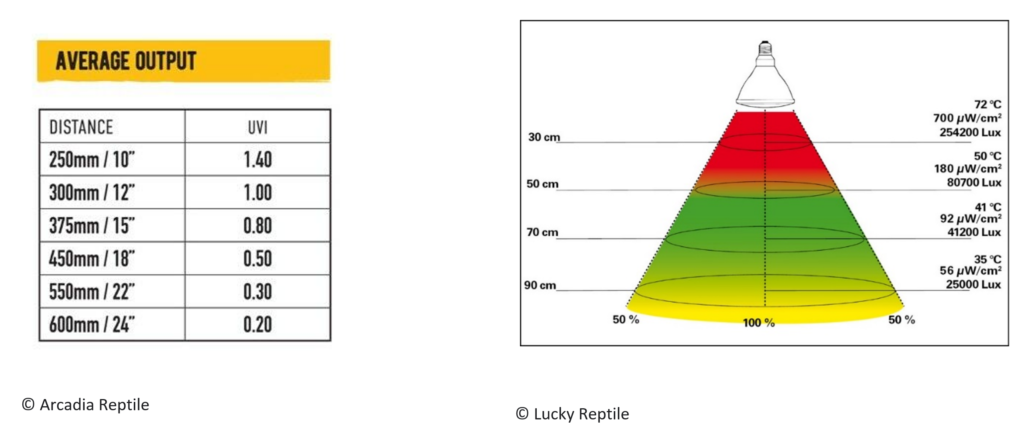
I’m not going to go into why these are different, or why one may be preferred over the other, as that is a whole other essay in itself. In the hobby, the most common one I see is UVI. UVI was internationally recognised in the 90’s, and it’s based on measuring the intensity of sunlight and its ability to cause skin reddening (called erythema). The parts of UVB measured for erythema are very similar to the parts measured for an important biological process – Vitamin D synthesis.
Reptile enthusiasts use UVI as a direct proxy for determining appropriate levels of UVB for their animals. So, for that reason, I’ll be referring to UVI in this write-up. The standard is now set…
What is %?
The percentage value you see on a box or UVB lamp generally tells you how much of the total energy output from the lamp is emitted as UVB. Or at least that’s what it’s supposed to do.
So, for example, Lamp A is a 5% UVB lamp. Let’s say that it emits “100 photons” of light. This lamp will emit 5 photons of UVB, and the rest will be other forms of light (such as UVA or visible light).
Now, we take Lamp B. It’s a 10% UVB lamp. When it emits 100 photons, 10 of them will be UVB. Makes sense, right?
The 10% lamp must be stronger, because it emits more UVB, right?
Well, not exactly. You see, we’ve compared the lamps based on 100 photons being emitted. But consider that those lamps don’t both emit 100 photons per second. In actuality, Lamp A emits 100 photons per second, but Lamp B only emits 20 photons per second.
So now, if we compare the amount of UVB emitted per second, Lamp A emits 5 UVB photons, and Lamp B only emits 2 UVB photons! So, Lamp A actually emits more UVB despite the lower % value.
Here’s another way of seeing it. We can compare the two bars below.

Which bar has more blue?
The bottom bar has 25% blue, so if we go off the % value then we can assume that it has more blue overall.
But it’s obvious that the top bar has more overall blue than the bottom bar, even though the top bar only has 20% and the bottom bar has 25%. The % value does not give us all the detail that we need. Looking at the % value isn’t giving us context on the overall bar, and it’s not a way of comparing the two bars.
This shows that when comparing any lamps, we need to take into consideration their entire output, not just the percentage value – but of course the manufacturers generally don’t tell us the overall output. A real-life example of this can be seen when comparing say an Arcadia 6% UVB T5HO lamp to an Arcadia 7% T5 lamp or 10% T8 lamp. The 6% T5HO lamp has an overall higher output, so the amount of UVB produced is also higher (aka, a 6% T5HO is stronger than a 7% T5 or 10% T8).
To absolutely hammer home the point, take a 14% T5HO lamp – it emits a lot of UVB in theory, right? Consider then that full sun is less 1% UVB – but still has “more” UVB than the 14% lamp. The % value has nothing to do with it.
“But the 12% is still better for Bearded Dragons/Tortoises/Tegus/etc”
We’ve discussed why % isn’t a good measure of a lamp’s overall output.
But why do so many people still use certain bulbs for certain animals?
Part of this comes down to ease. Most Facebook groups are run by a group of volunteers, with families and jobs and lives outside of animal care. It makes perfect sense for them to make things as simple and easy as possible for their visitors and members. They make colourful diagrams and explanations of what equipment to use – and they stick to it.
But, as with all things in life, nothing is ever this easy. There is no “one size fits all” approach to lighting reptiles. And this should always be considered when dealing with people who are struggling with their setups.
I’m a firm believer that just telling someone something isn’t very valuable, it’s only valuable if it is explained and there is knowledge shared and something learned. That’s why seeing single answers on forums like “you need a 12% lamp” is such a personal bugbear, even though I recognise why it is done. The amount of oversimplification in these answers doesn’t do the hobby any favours, and only leads to things being made worse further down the line as knowledge becomes diluted as it spreads.
Let’s say you’ve been told that you need a 12% or 10.0 T5 lamp. That’s what the person on the Facebook group said, and pretty much everyone agreed.
We first look at the fact that simply searching “10.0 T5” on Amazon (US) brings up some tried and tested poor performing lamps:
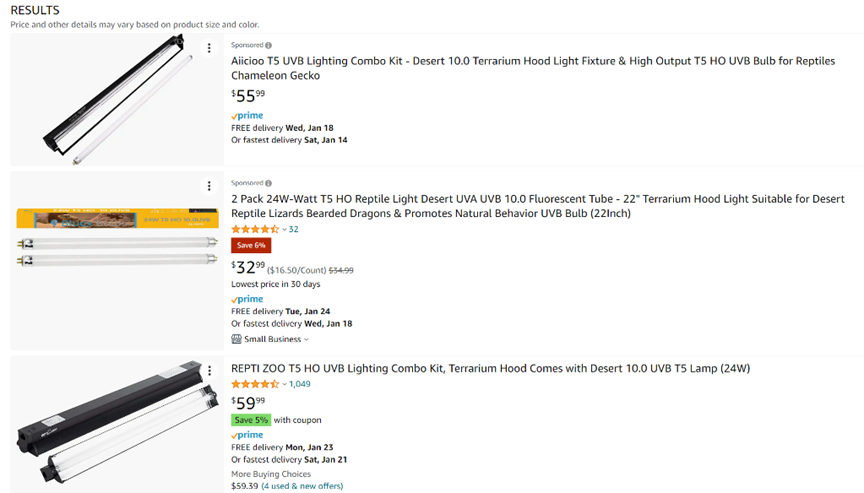
These lamps are all inappropriate for the average user (not discussed here in detail, but something that the hobby knows about thanks to independent testing). It’s a shame that they are still on sale. But they do say 10.0 on them, and they look like the sort of thing people online have in their enclosures. This is the first hurdle to overcome.
Let’s say that the online forum told us to get an “Arcadia 12% T5” – a very reputable lamp. So, we go online and buy the lamp, and we set it up in our enclosure. It looks like it’s working, we’ve set it up alongside our heat lamp and it’s about 40cm away from our tortoise’s back. Seems ok!
But what we weren’t told is that, in this case, the lamp needs a reflector. Alone, the lamp emits UVB, but most of the UVB is shining up into the air and not down onto our animal. We did exactly what the forum said, we got a 12% T5 from Arcadia. But we still didn’t get it right. This is the second hurdle to overcome.
Ok, so another forum said for our beardie we need a 24W 12% ProT5 from Arcadia. This is getting more specific. They told us that the 12% was for desert animals. We’ve bought it, we’ve set it up in a 4x2x2 enclosure and our beardie is basking. All seems fine. But, what nobody has recognised is that because the basking area is only 22cm away from the lamp, the bearded dragon is actually being exposed to fairly dangerous levels of UVB. How can this be? The lamp emits 12%, and that’s right for dragons, right? This is the third hurdle.
The First Hurdle – It’s about the lamp
Not all lamps are made equal based just on the % value, we know this after looking at the coloured bars from earlier. And unfortunately, not all brands will play to the same rules. Some brands will label their lamps with a % value that isn’t even true. I’m not going to go naming companies that do this, but it’s apparent from independent testing that some brands simply put buzzwords and numbers on their boxes for sales purposes.
This is one of many reasons why I believe that it is important that lamps are tested completely independently of the manufacturer or brand. Tests should be conducted by a third party. And luckily for us, some brands have been very open and accepting of independent testing. Such brands have been tested so much by external parties and by the hobby as a whole that we can be confident in their ability to produce consistent results.
That said, even after some tests have been completed, brands often don’t change their naming conventions. This is where the hobby as a whole must come together to promote proper recommendations based on results from large sample sizes and not based on what’s on the box.
The Second Hurdle – It’s about the reflector
The reflector makes all the difference to the total output. The same lamp may perform very differently in different reflectors.
Here’s another visual example:
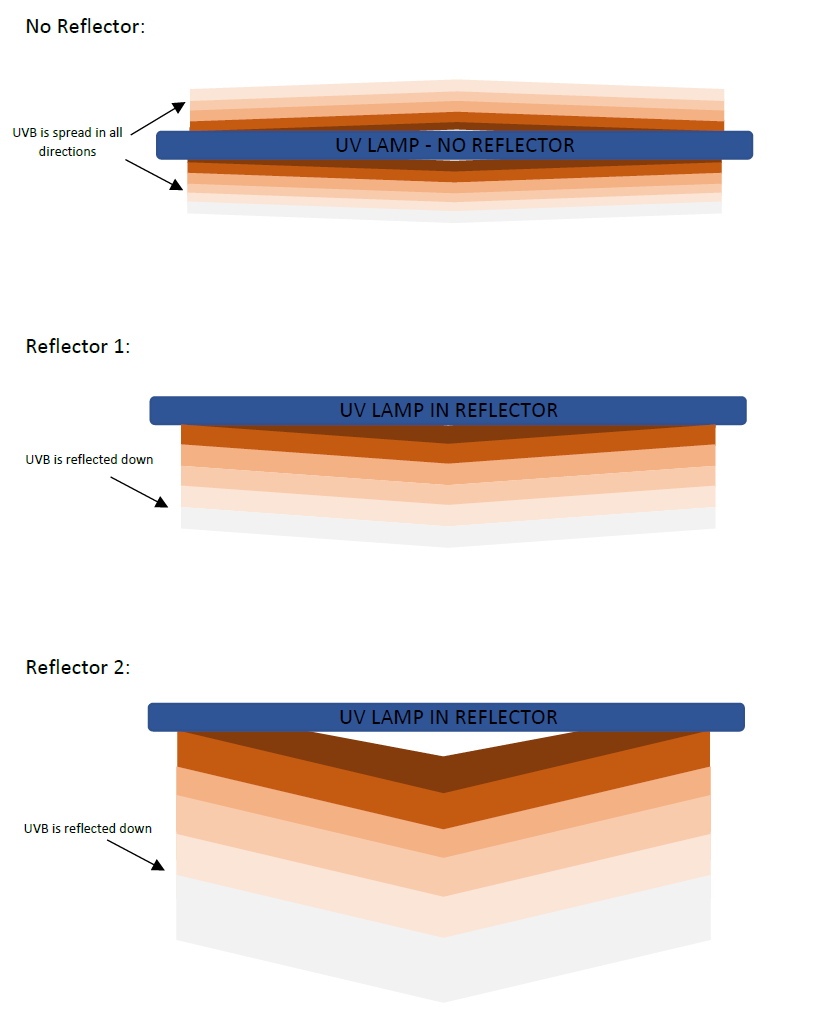
Notice how the second reflector is pushing the output further? That’s because the reflector is making all the difference. The lamps can be identical, but the reflector that they are in can dramatically change the output. This is irrespective of the % value of the bulb.
It doesn’t necessarily have to be anything to do with how “shiny” it is either. There are plenty of examples of shiny surfaces that don’t reflect UVB. The shape of the reflector also changes things significantly. Tiny, almost imperceivable, differences in the shape can affect the output drastically. This is because of something called the parabolic reflector effect. Similar to how a magnifying glass can pinpoint sunlight to create a tiny hotspot, a reflector on a fixture can focus the UVB more depending on its shape.
The Third Hurdle – It’s about distance
The further away you move from a UVB bulb, the less UVB you will be exposed to. In its simplest form, this is because the UVB has “spread out” so thin that it’s essentially non-existent anymore.
You can test this exact same effect yourself very easily. Shine a torch at a close object, and it will be brightly lit. Move the object further away and there will be less light hitting the object, it will be less brightly lit. UVB from a lamp works in the EXACT same way, because UVB is light, the same as the light from your torch!
We want our animals to be the right distance away from the lamp. Two different % lamps, in two different reflectors can both produce the same results.
Let’s use the same examples from before, and let’s label the areas of UVB intensity.

After doing some research, we’ve concluded that our pet lizard needs “Moderate UVB”. If our setup was using Option 1, our lizard would get “Moderate UVB” exposure at around 20cm away from the UV Lamp. But, if we used Option 2, then we would want our lizard to be around 40-50cm away in order to be exposed to “Moderate UVB”.
Two setups, with potentially very different % bulbs, in different reflectors, but we can expect the same exposure to “Moderate UVB” based solely on how close the lizard is to the lamp.
Equally, someone with a tortoise that only needed “Very Low UVB” could use the same lamp and reflector that we’re using for our pet lizard, but use it at a different distance, and it would still be suitable!
The next step to this is to remember that anything between the lamp and the animal will reduce the measured exposure to UVB. This includes a mesh guard around the lamp. So, two identical lamps in identical reflectors will have very different effects on an animal if there is a mesh guard in the way.
What we actually want to measure
Forget the %. We’ve discussed why this, for the most part, is irrelevant. It’s not a measure of how strong a lamp is.
As I alluded to earlier on, most people use UVI as the measure for UVB exposure. This unit of measurement is valuable as it is globally accepted as a standard when it comes to sunlight exposure.
Some fantastic work has gone into discovering the levels of exposure that animals naturally get, given their behaviour patterns and what their natural ecosystem is like (harsh deserts to shaded jungles). There are multiple online resources that can be used to determine what UVI your reptile may naturally expose themselves to.
Once you know this, you can make the necessary arrangements to get the same UVI in the basking area of your enclosure; taking into account the lamp (including its % value), the reflector, and the distance.
There is a single tool that is recognised and recommended for this, the Solarmeter 6.5 (or 6.5r). With this invaluable tool, a keeper can ensure that their animals are exposed to an appropriate level of UVB – and they can monitor the decay of the output from their lamps so that they know when to buy a replacement.
This doesn’t mean that everyone needs to own a Solarmeter 6.5 though – thank goodness. As we discussed when looking at The First Hurdle, some brands are so widely used and are so consistent in their quality that the output of their lamps is predictable without the need for a Solarmeter. They’ve been tested, independently of the manufacturer’s claims, in different reflectors and at different distances. This means that the hobby can provide very accurate advice based on previous testing alone – no Solarmeter needed.
So, what does this mean for someone wanting to buy a bulb?
This article isn’t meant to confuse anyone. It’s supposed to open the eyes of those people giving advice on forums and Facebook Groups without a full understanding of the situation. And it’s supposed to broaden the horizon for new keepers, showing them just how much information there is to gather about their companion animal.
What it does mean, though, is that one size simply does not fit all. And that asking a question like “what lamp is best?” will only bring out similarly vague answers. We as a hobby should come together to educate about lighting, husbandry, care, and all things relating to our animals. Just because someone is new to a hobby doesn’t make them any less capable of understanding how it works – in fact someone new to the hobby is perfect for “moulding” into an ideal keeper, they’re the perfect vessel for stopping the spread of misinformation because they can get good information from the start.
If you are someone wanting to buy a UV bulb for your pet, give as much information as possible to those whom you ask for help. Tell them about your enclosure, tell them how far away you want the lamp to be from your reptile, and let them know if you have any plans in the near future for upgrades.
Equally, if giving advice, remember that there are so many nuances and variables involved in animal husbandry that it’s simply impossible to give quality advice in a single sentence. If you are trying to give husbandry or lighting advice and your answer is just a few words – then the advice you are giving probably isn’t great.
Disclaimers
In the section “What is %?”, of course, this isn’t actually how lamps work. They emit much more than 100 photons per second, and we aren’t ‘counting’ photons in real life, we’re measuring energy. This is just a simple way to explain an otherwise complicated subject.
I’ve purposefully not mentioned the Ferguson Zones.
The Solarmeter 6.5 is limited in its uses. I recommend that it is only used on independently tested lamps. I discuss this here.
Links
Arcadia’s Lighting Guide: https://www.arcadiareptile.com/lighting/guide/
Zoo Med’s Guides Section: https://zoomed.com/search-by-animal-caresheets/
Exo Terra Rating System: http://www.exo-terra.com/en/explore/new_uvb_rating_system.php
Solarmeter 6.5 discussion: https://tomaskas.co.uk/solarmeter-its-uses-and-limitations/
This article is designed to be read in it’s entirety. If you wish to provide a quotation from this article anywhere else, you must share a link to the entire article along with a statement such as “to get all of the details, please read the article in full”. Please refrain from posting select sections of the article, as this could give a false representation of the independent and honest information provided.