
Introduction
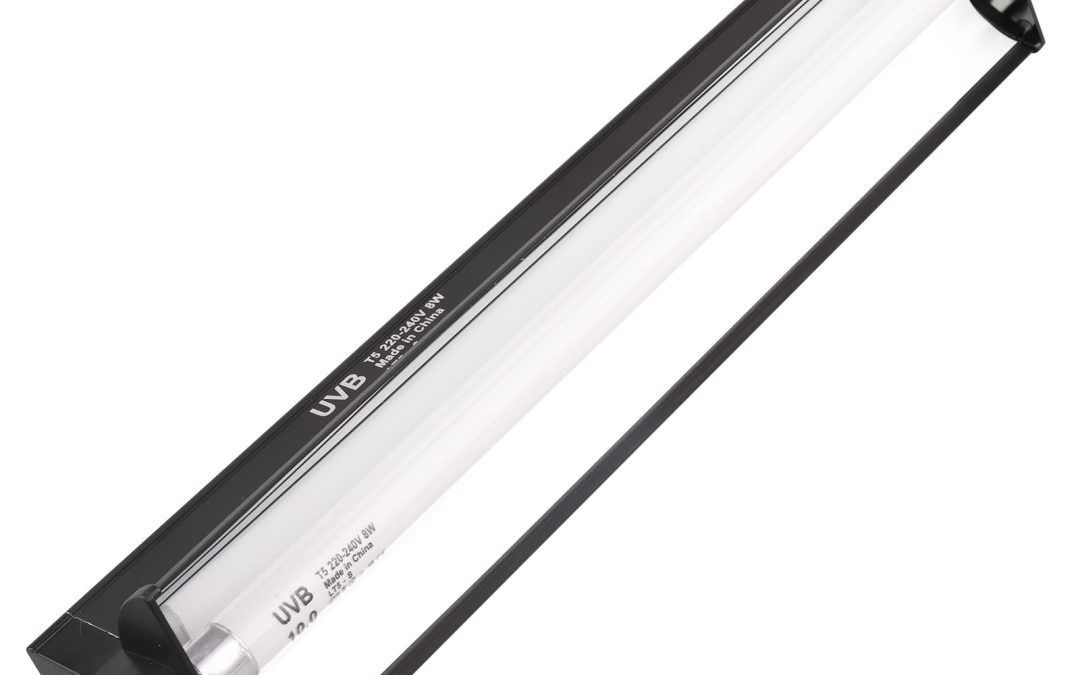
One thing is for sure, there’s more and more UVB bulbs, fixtures, and kits than ever before available online. It’s never been this easy to get online and get something with “UVB” written on the box.
People are often recommended to go with T5 UVB lamps, which makes sense because they work really well for a whole host of setups.
Head to your favourite online seller and type “UVB T5 10.0”, “UVB for Tortoise”, or “UVB for Bearded Dragon” and you are flooded with brands with hard-to-pronounce names and kits that all look near identical. They are often sold as “Desert” or “10.0” lamps, and sometimes have a picture of a lizard on the listing.
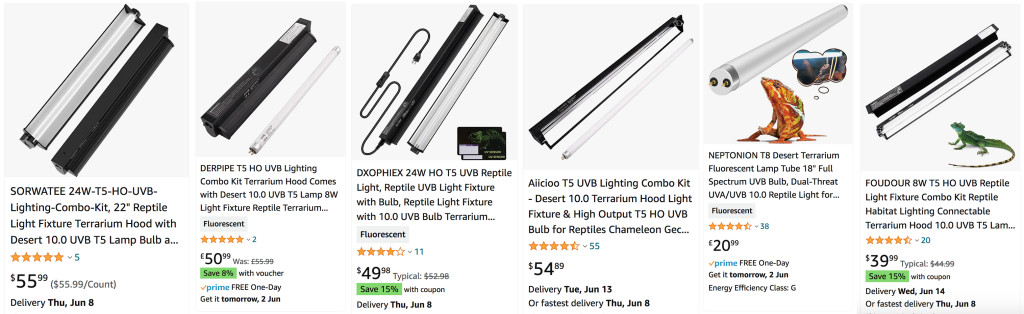
To make matters worse, many often have names that are remarkably similar to well-established and recognised product lines. Examples I’ve seen are Reptizoo (similar to Zoo Med’s Reptisun line), PlusT5 (Similar to the Arcadia ProT5), and Evo Terra (Similar to Exo Terra).
Of course, these similar products are NOT the same. But how do we know? They look the same, right? It says 10.0 on it, right? What if we just change the bulb and keep the same fixture? Let’s start with the fixtures…
The Fixture – is it a danger?
I’ve tested far more T5 UVB fixtures than I’d like to think about. From brands located in the US, UK, Australia, and Asia. And it’s safe to say that the quality control is not the same across the board.
Just because two fixtures look the same on the outside, does not mean that the reflector works or that the electronics on the inside are the same.

It’s not only the reflective surface either.
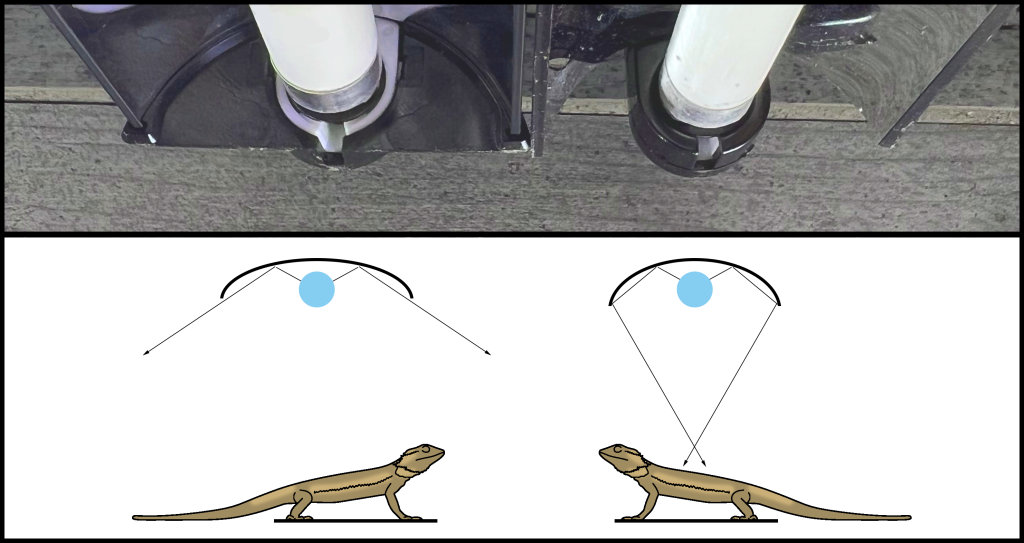
Sometimes, tiny (almost undetectable) differences in the shape of a reflector itself will make a huge difference to the overall output of a lamp. It’s not dissimilar from the parabolic effect that forms an important aspect of satellite design for NASA, incandescent lamp design, and microphone design. Below I’ve tried to illustrate this, you can see examples above of two real reflectors as well as not-to-scale illustrations that give an idea of how UVB emitted from the lamp can be focused downwards just be a small change in reflector shape.
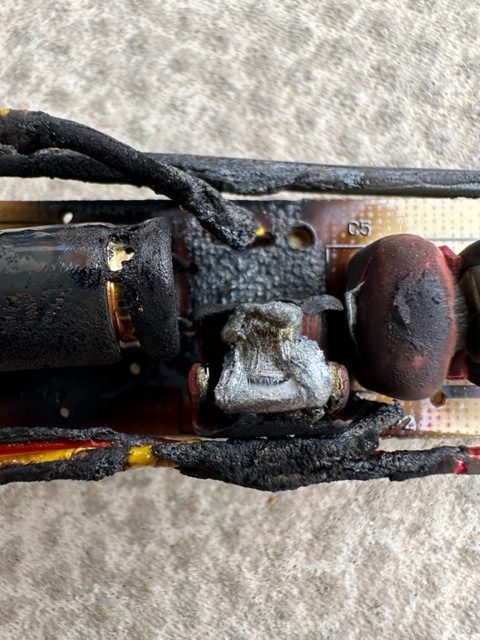
Perhaps the most worrying thing about these cheap fixtures is that they have a much lower quality control. Worryingly, when I’ve taken taken these fixtures apart, I’ve found awful things going on inside.
Routinely, I’ve seen Earth/Ground pins that are loose and not actually connected on the inside – this is perhaps the most common problem. This leads customers into a false sense of security. Without the metal unit being grounded and properly insulated, users run the risk of electric shock.
Although, on a few occasions I’ve seen much worse. Take a look below, it’s a prime example of cheap components. Running at normal voltage, this unit caught alight and burned away components on the inside. There was very little smoke – and had I not already been aware of what a burning capacitor smelled like (it’s a sour smell from the electrolyte inside) then I may have kept running the unit. This is a REAL fire risk. And it’s one that I don’t want any pet owner to have to face.
The T5 Tubes – So, why exactly are they so bad?
They sound the same as the known brands. They have “10.0” on the box, and they say that they are suitable for desert animals. What’s the worst that could happen?
This section needs you to understand at a very basic level how a fluorescent T5 lamp works. Below is a mini animation to help.
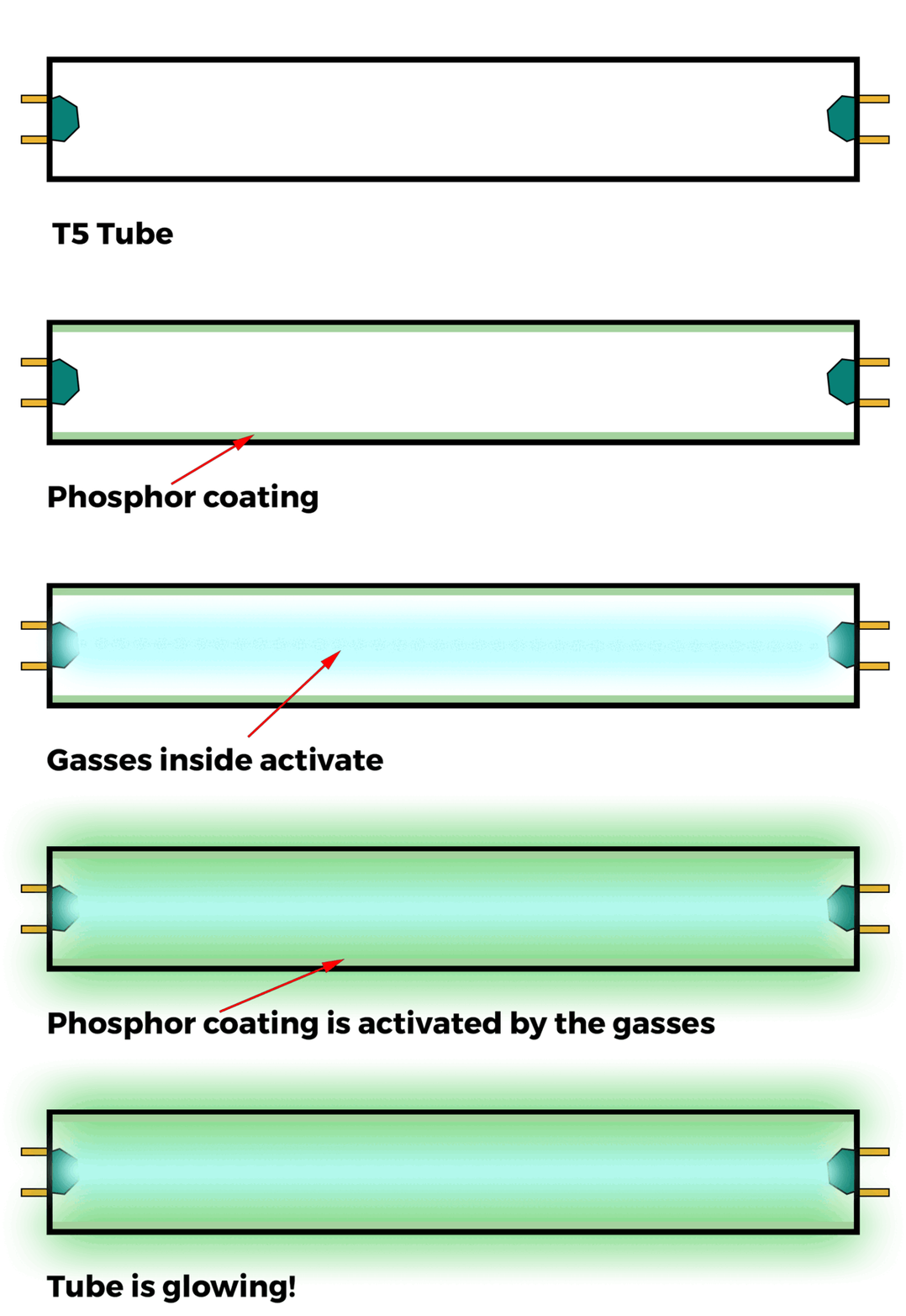
The phosphor coating is an integral part of this. The chemicals on the inside of the tube are dangerous, and the phosphor coating essentially “converts” the output into a safe one…or at least it does on high quality units.
It’s the phosphor coating that creates a good UVB output in decent lamps. There are specialist, patented phosphor blends used on the best lamps. The chemicals used, and the proportions that the chemicals are in, is a valuable secret – something that manufacturers want to keep to themselves, just the same way that granny’s special recipe apple pie is.
So, this means that only a few manufacturers have access to high quality phosphor blends, and they are all made in Germany. Other companies have to create cheaper knock-off versions, often in China. And it’s these cheaper blends that end up in the cheaper tubes, which end up in the kits that we find on Amazon.
The most obvious problem with the cheaper blends is that they decay very quickly. I’ve seen 50% decay in the first 2 months – which is awful! To compare, the higher quality blends usually take 12-15 months to decay by 50%.
What’s worse, with the cheaper phosphors, the coating itself is unstable. This means that it is prone to cracking. When it cracks, it allows the radiation from the inner chemicals of the tube to pass through the glass tube unhindered. This essentially means UVC (which is deadly) leaks out into your enclosure and onto your animal.
But I use these and they are fine. My Beardie/Tortoise/Tegu is healthy and happy
I urge you to do some further reading. And if you are not willing to do such reading – then I don’t think that animals are for you. Stick to pet rocks.
The recommendations – what should we use?
At the time of writing, there’s only a few brands that I feel confident recommending:
Zoo Med
Arcadia
Reptile Systems
Leap
However, please be aware that just because a lamp has one of these brands on the box does not mean that I recommend it. All recommended lamps belong to one of these brands, but these brands do not always have recommended lamps.
Always always always get advice if you have any questions, there is no such thing as a silly question. Get in touch for a private consultation or you can contact one of the above brands for advice on their products.