

You’ve set up your enclosure, it’s got plants and hides and your pet is enjoying themselves. You’ve got a heat lamp and a UV lamp hanging above the enclosure and it all looks pretty decent.
Did you check for UV Shadow? What even is that?
I want to start off first by saying that UV Shadow isn’t a scientifically agreed term in the context of animal keeping. A quick search online shows that UV Shadowing seems to be a technique for detecting DNA in a laboratory. That’s not what I’m talking about when I say UV Shadow.
Because Ultraviolet, or UV, is light, we can draw direct comparisons between it and visible light. This makes it easier to explain.
You understand how shadows work of course, a shadow appears on a surface if there is something opaque between the surface and a light source. You (the opaque object) stand in the sunshine (the light source is the sun), and produce a shadow on the floor (the surface).

The same is true in an animal’s enclosure. If we have a lamp above an animal, and then have something in the way of the lamp, then it will cast a shadow on the animal. But that’s obvious, right? We all know how shadows work! I’m teaching you how to suck eggs here.
Well the exact same is true for UV, only this time we can’t see it with our eyes. If we have a source of UV and then put an object such as a plant or another lamp in the way, there will be a “shadow” under the object – there will be a UV Shadow.
We can visualise UV shadow if we use a device that can “see” UV(B), such as a Solarmeter.
If we measure with a Solarmeter, it is clear that a plant in the way of the lamp creates a shadow effect of lower UV exposure. This can often be seen with out eyes in most animal setups, because generally UVB sources also emit visible light – and if there is a visible light shadow, then there will be a UV Shadow too.

So, a UV Shadow is an area that has been blocked by an opaque* object.
This poses a problem for keepers, because they may believe that their pet is under a UV lamp, but in reality they aren’t fully illuminated by the UV and getting as much of the benefits from exposure as the keeper may think!
So how do we fix it?
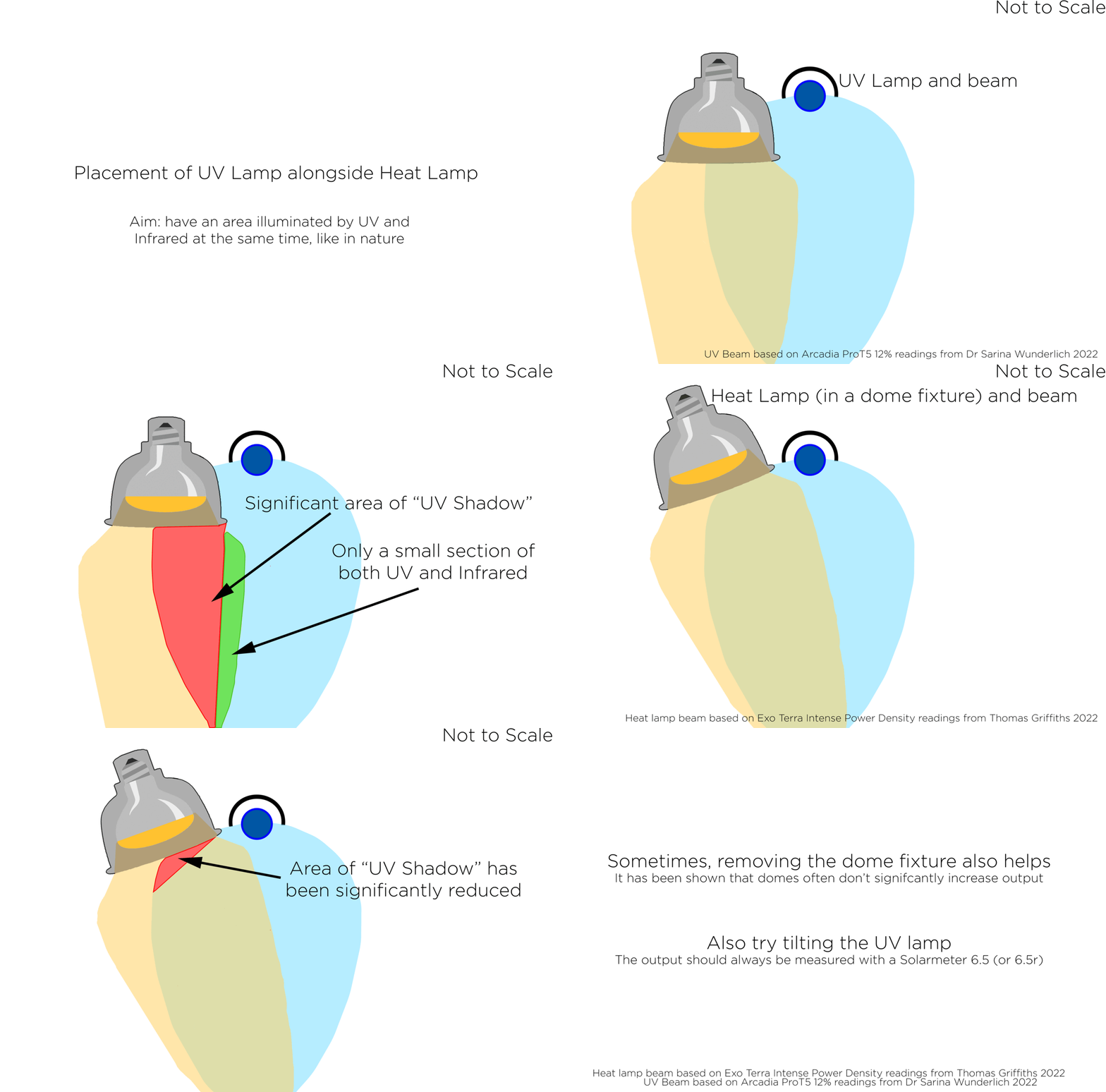
*An object that is opaque to UVB may not be opaque to visible light – for example some types of glass block UVB but not visible light and so appear as clear to our vision.