
We’ll be talking about some fairly in-depth stuff here, if you have trouble understanding any of the content or would like to see some reference material, please get in touch.
The UV Index, first officially used in 1994 and implemented by the World Health Organisation, was intended for measuring the effects of Ultraviolet as part of the natural solar spectrum, not an artificial source such as a man-made lamp.
The solar spectrum contains wavelengths involved in both the production of Vitamin D3, as well as the regulation of Vitamin D3. The use of both groups of wavelengths creates a delicate balance in the body of photoproducts – thus allowing a controlled production of Vitamin D3 in the body. Dr. Frances Baines coined the term “molecular sun-dance” to refer to the equilibrium of different photoproducts created when skin is exposed to the solar spectrum, but the effect itself was first documented by Holick et al. back in 1981.
The UV Index wasn’t designed to be a factor or measurement for anything other than sunlight – so the more different a spectrum is to when compared the solar spectrum, the less effective the Index is for factorising the information from the spectrum.
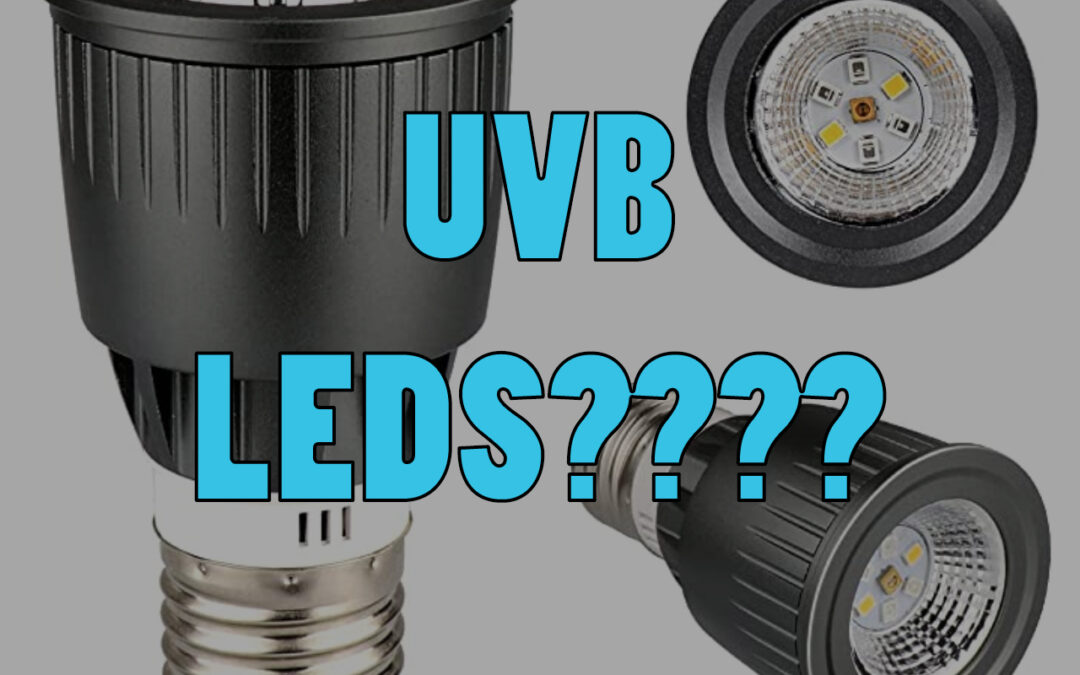
LEDs of all kinds are naturally very narrow-band – that’s just the way that they are. Some (usually “White LEDs”) do have a phosphor involved to help create a wider spectrum. So far, to my knowledge, no UVB-emitting LEDs utilise a phosphor technology.

Because of their narrow-band nature, a single diode cannot possibly emit a spectrum that contains both the wavelengths associated with Vitamin D3 production as well as the wavelengths associated with regulation.
Often, a study by Cusack et al. in 2017 is cited for illustrating this. In short, the researchers exposed some Bearded Dragons to UVB LEDs with a UVI of just 0.24. For the record, this is extremely low – even negligible. When exposed to the LEDs, the animals still produced significant levels of 25(OH)D3 (essentially the Vitamin D that we find in blood). For comparison, when exposed to another [normal] UVB lamp with a UVI of 0.92 (still low, but 4 times higher than that of the LEDs), the animals did not have raised 25(OH)D3 levels even after 11 months of exposure.
This is because the LEDs were emitting wavelengths associated with Vitamin D3 synthesis but not wavelengths associated with Vitamin D3 regulation. The term used here is “all the breaks were off” – the body couldn’t stop synthesising Vitamin D3.
The risk here is, if the animals are exposed to something more standard (say, UVI 4.0), what would happen? If 0.24 can produce significant levels of 25(OH)D3, we daren’t think of what UVI 4.0 could do! The question on everyone’s lips is whether or not UVB LEDs at “normal” UVI would lead to hypervitaminosis D (aka Vitamin D toxicity).
We’re working with some of the world’s best minds on something to bring a bunch of information closer to the scientific community. We’ve worked with a lot of UVB LED products and prototypes, and we hope to update you all soon on our findings!
This article is designed to be read in it’s entirety. If you wish to provide a quotation from this article anywhere else, you must share a link to the entire article along with a statement such as “to get all of the details, please read the article in full”. Please refrain from posting select sections of the article, as this could give a false representation of the independent and honest information provided.