

TO PRINT THIS PAGE CLICK HERE
This write-up is a follow on from “Full Spectrum LEDs aren’t full spectrum”. Please read that first.
Let’s start with something we tend to all agree on:
“Don’t use coloured lights on your reptiles”
You can’t go into a forum without stumbling across a statement like this at some point. I’ve seen some downright rude attacks on people who have mistakenly put a red heat lamp over their bearded dragon.
In fact, very often you’ll see people saying that coloured lamps are dangerous, hazardous, and deadly to reptiles. I’ve seen it touted that coloured lamps will damage the parietal eye (the “third eye”, as it is known) on lizards, often with no literature being cited.
But, then in the same breath, people will be advised to use LEDs to make an enclosure brighter. It makes sense, adding a nice bright white light will brighten up the enclosure and will certainly play an important part in helping to wake up your reptile – even having an effect on hormone regulation.
You can take lux readings before and after adding an LED to find some impressive increases in light levels in an enclosure. But it would be naïve to think that this is the full picture.
Humans have a host of special photoreceptive cells in our eyes called “cones”. This is a fancy way of saying that we can see in colour. A normal-acting eye will have 3 distinct types of cone. Each type responds to different types of light – different colours:
L Cone (Longwave cone) – associated with reds
M Cone (Mediumwave cone) – associated with greens
S Cone (Shortwave cone) – associated with blues
Our determination of “pure white” depends on how much these cones are activated. If they are all activated in natural proportions then we perceive “white”. If the S Cone is activated whilst L and M are not, we perceive a deep blue.
Here’s that LED from the previous article, with an overlay of human cones in relation to their wavelength sensitivity:

The LED appears white because it activates all three cones. And it appears “cool white” because the amount of activity on the S Cone is disproportionally more than the M or L Cones.
Reptiles are different to humans, and they’re also different to each other. Different species see different colours. But generally speaking, from our current understanding, they can all see UVA. To them UVA is just another colour like our Red, Green, and Blue.
Some species appear to be more sensitive to UVA than others, probably because they have evolved some kind of display of this fancy colour, or because they are active during parts of the day (or night) when UVA is in higher proportion to other parts of the spectrum compared to broad daylight.
Either way, they can see UVA as a colour. Thus, for a reptile to perceive “pure white”, they would need this extra cone to be activated in proportion to the other cones.
We can hypothesise that an “average” UVA-sensitive Cone (AKA U Cone) for an “archetypal” reptile (whatever that may be) would apply like this (not to scale to the human cones and is illustrative only):

See the end of the article for references and how this “average” U Cone was determined.
Notice something?
The LED has practically no activity in the U Cone’s sensitivity curve. This means that it is not white to the reptile. It’s not dissimilar from only activating the M and L Cones in a human, which creates a deep orange colour. We can presume that by not activating the U Cone, we are doing a similar thing to reptiles.
You know what that means? If you’re putting an LED over a reptile, you’re giving it a coloured light. Awkward for those who will scream until they are blue in the face that coloured lights are dangerous.
We’ve previously spoken about the Lighting Questionnaire, and some of the preliminary results. We have noticed so far that many keepers believe that they provide UVA for their animals.
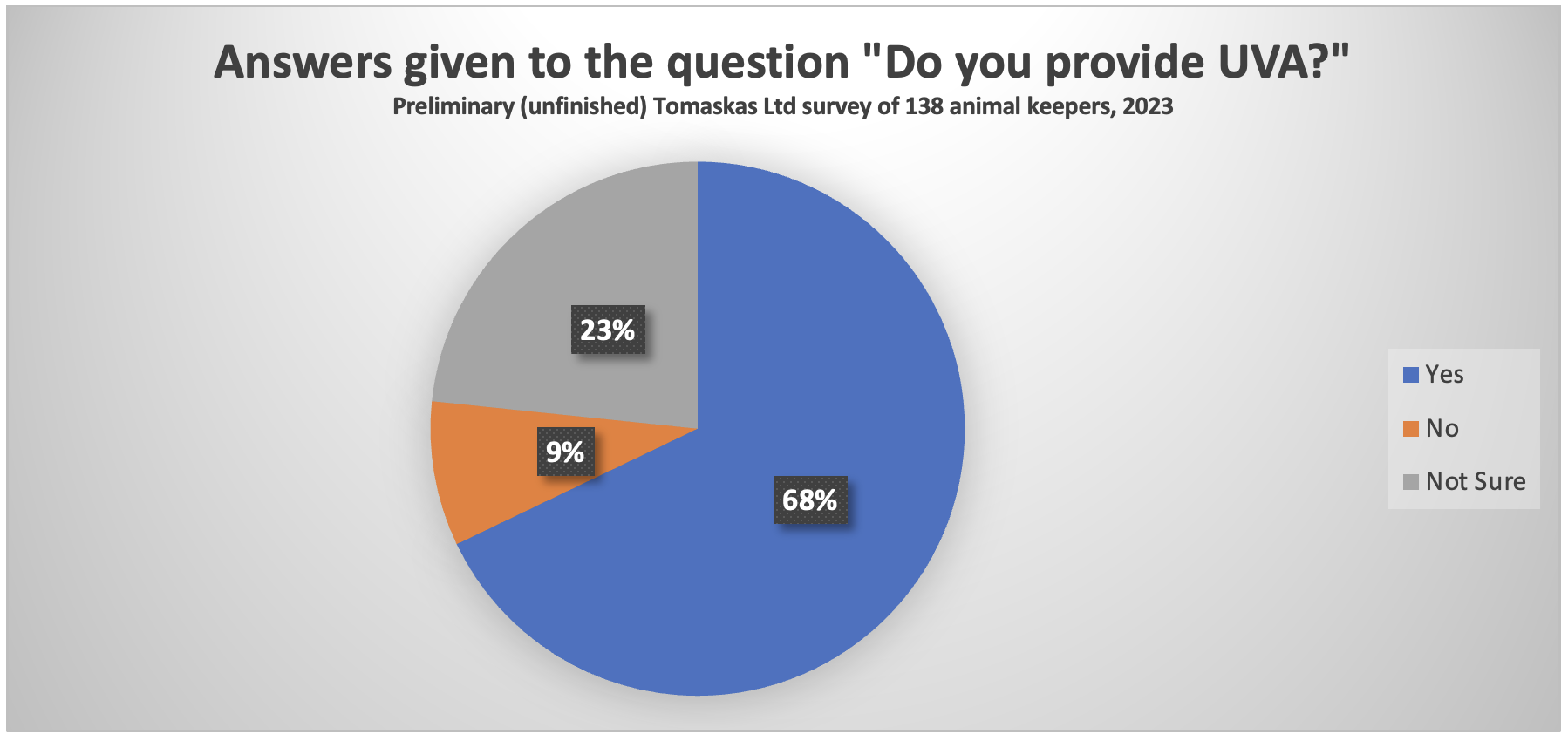
Of the people that said yes, some provided the following explanations in the follow up question asking for details of ways in which someone could ensure they are providing UVA to an animal:
| “Deep Heat Projector” | “UVA is heat, just use a heat lamp” | “Plant LEDs” |
| “UVB LED” | “Halogen” | “LEDs provide lots of UVA” |
| “LEDs are white” | “UVA is just light, so any light” | “Jungle Dawn LED” |
From that, it’s clear that there is a lack of understanding in keepers about how we provide UVA. Who is to blame? Who hasn’t educated keepers well enough? We can get really deep into that question, but one obvious contender are the brands that put “UVA” on the box of their heat lamps.

So your heat lamp emits UVA…right?
Well, if we actually take a look at it, UVA is less than 1% of the output of a heat lamp. Take a look at a typical halogen heat lamp compared to the same curves for the cone cells:
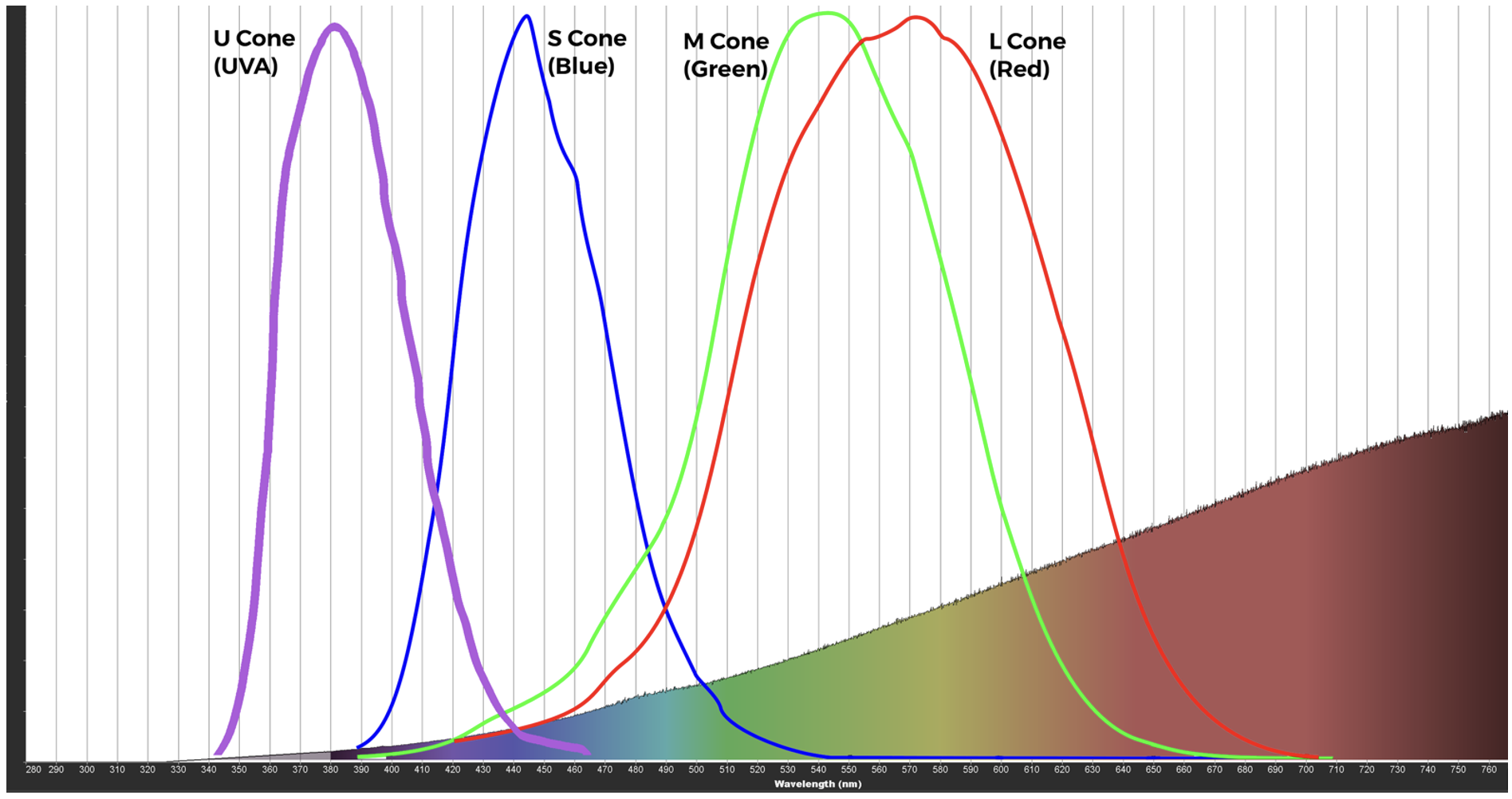
It’s hardly a UVA lamp, that’s for sure.
At some point in the near future, I’ll get into why fluorescent UVB lamps shouldn’t be seen as UVA lamps either. But that is for another day.
Of course, this write-up isn’t meant to upset anyone – and there isn’t really a conclusion at this point in time. It’s more of a quick explanation as to why I find irony in people on the internet saying that coloured lamps are bad but LEDs are good.
Don’t get me wrong – I use LEDs a lot. And I don’t want anyone to stop using them. I just think that people need to understand the limitations of the lamps they use and expose their animals to.
This article is available as a printable PDF here
Want to help support what we do? Much of the lamp testing we do for public release is paid for out of pocket – which means it is done at a loss. You can help to support us by donating. This helps us to cover the costs of lamps and equipment. To find out more, click here.
This article is designed to be read in it’s entirety. If you wish to provide a quotation from this article anywhere else, you must share a link to the entire article along with a statement such as “to get all of the details, please read the article in full”. Please refrain from posting select sections of the article, as this could give a false representation of the independent and honest information provided.
I have made reference to the following in this write-up:
An excellent article compiling together a whole host of studies on reptile photoreceptors. It is from this article, as well as work with Dr Sarina Wunderlich, that the hypothetical U cone was determined
https://www.frontiersin.org/articles/10.3389/fevo.2019.00352/full#:~:text=Reptiles%20possess%20different%20types%20of,(rrod%20and%20cones)%20retinae.
ASTM Solar Reference Spectrum
https://www.astm.org/g0173-23.html
Tomaskas Ltd Lighting Questionnaire
https://forms.gle/LRRhT5wTSFZpeszY6