

TO PRINT THIS PAGE CLICK HERE
We recently conducted a survey, and although it’s not finished at the time of writing this article, the preliminary results are pretty clear: people have some mixed ideas about what they consider to be “Full Spectrum”.
Most people associated the term with “Sunlight Replication”.

I often see people referring to different lamps as “full spectrum”, from manufacturers to influencers:

I’ve chosen the above because of the implications that the lamps do something special, or that they somehow replicate sunlight. This is a real problem when it comes to these brands that heavily market their products. “Pure full spectrum energy” sounds impressive, doesn’t it?
First, what does “Full Spectrum” actually mean?
Zoo Med has a nice education centre on their website – and they use the following definitions:
“Full Spectrum: The term “Full Spectrum” is used rather loosely but can usually be expected to mean that the lamp produces close to the full visible spectrum of light. These lamps often operate in the range of 400 – 800 nanometers and simulate the optical brilliance of outdoor light at noontime. Often incandescent household lighting products are sold as “Full Spectrum” even though they do not provide UVB or other essential lighting components.”
…and…
“True Full Spectrum: This is a term commonly used to discuss lamps that produce the full visible spectrum as well as UVA and UVB. When in doubt, check manufacturers’ packaging to determine if lamps do indeed provide UVA and UVB.”
I quite like these definitions. Because they’ve added some nuance for the reader. Personally, I would refine them further. This is because I believe the term to be used more for marketing now rather than for true scientific meaning.
True Full Spectrum: The full terrestrial radiation received on Earth on an average day, consisting of wavelengths ranging from natural UVB through to the longer wavelengths of natural Infrared, in the average proportions found in nature.
(I could of course expand this to refer to the ASTM standard, but I won’t for now).
Function-Specific Full Spectrum: The range of wavelengths associated with an appropriate biological function of plants or animals. For example; a full spectrum plant lamp emitting all wavelengths associated with photosynthesis (Photosynthetically Active Radiation), or an Ultraviolet animal lamp emitting wavelengths associated with safe Vitamin D3 synthesis.
Under these definitions, we can categorise lamps and setups accordingly. And it is categorically the case that no lamp on the market falls under True Full Spectrum. This is despite the marketing from the brands.
This is where I was going to put some spectral graphs, but I can’t do that without a big caveat first. In the aforementioned survey, we asked on a few occasions for the participants to identify lamps based on spectral graphs – and over 75% of people so far cannot do it accurately. To me, this means we need to take a step back and rethink how we display this information to beginners.
People struggle with the concept of wavelengths which are measured in nanometres (nm) and what numbers correlate to what colours. So, I’ve tried my best to really make this as easy as possible for you by labelling the graphs. Just be aware – the labels only apply to these specific graphs.
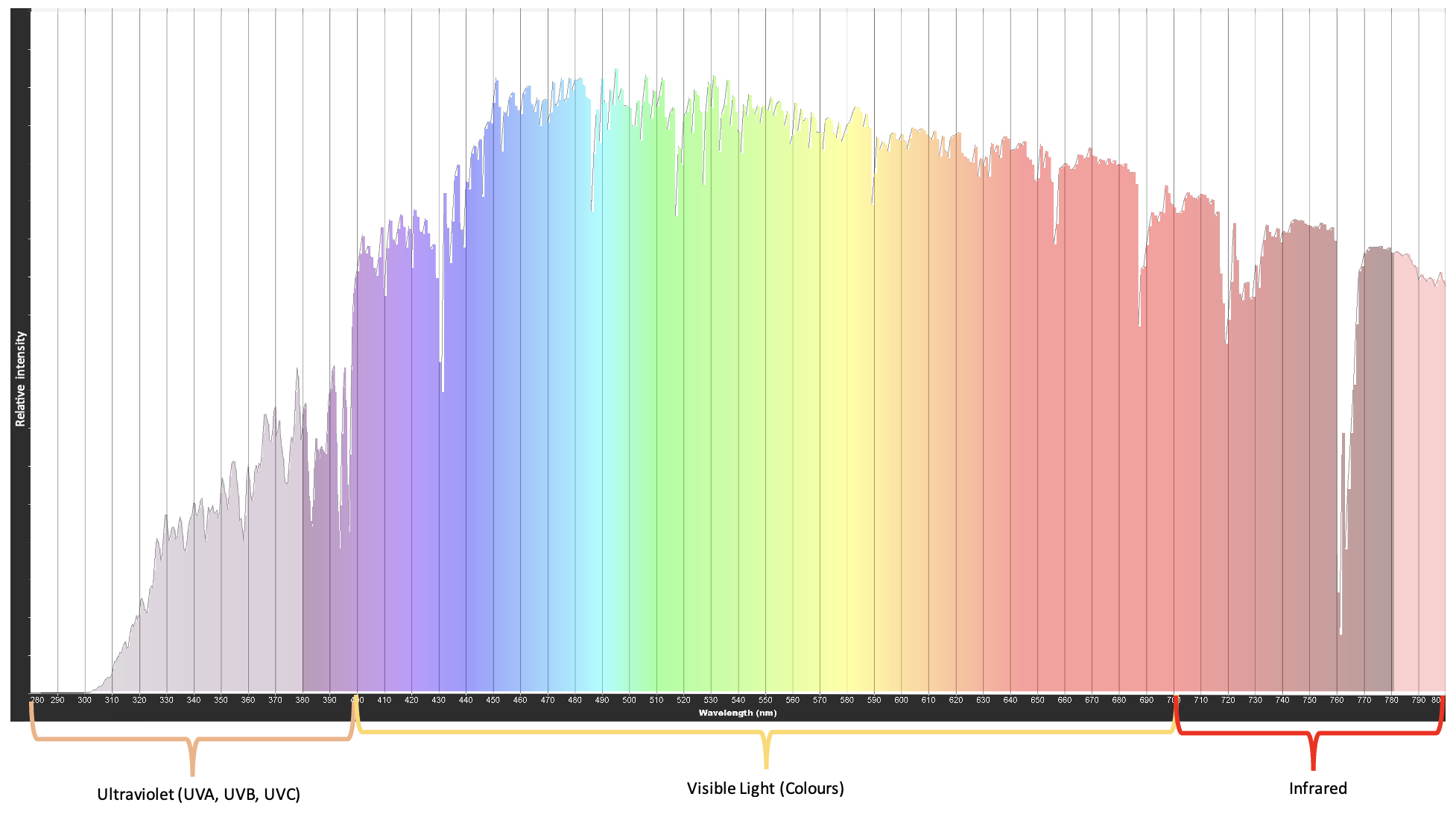
Here is a graph of average natural sunlight, we generally call this the ASTM spectrum:

We can see that there is some UV, quite a lot of Visible Light, and a fair amount of Infrared. And they are generally in proportion to each other. It’s worth noting that the proportions do change throughout the day and year, but for the sake of this we will disregard that.
I want to be clear, these definitions are man-made. In truth, there is no hard border between UV and visible light, and between visible light and IR, they blend together beautifully as one single spectrum. This is the True Full Spectrum as defined earlier.
Let’s compare that to the different lamps being marketed as “Full Spectrum”. Most lamps don’t emit much in terms of infrared, so we can get away with zooming in on the spectrum to get a clearer picture. Let’s zoom in on this part….

We get something like this, which again I’ve labelled:
Now, let’s compare that to the “Pure Full Spectrum Energy” from the Jungle Dawn LED Bar from Arcadia:

As you can see, it’s nothing like the True Full Spectrum of sunlight. And that’s not an attack on Arcadia, all current LED lamps on the market are like this. None of them are True Full Spectrum.
But, would an LED like this fit our definition of Function-Specific Full Spectrum?
For that, we need to consider what the lamp is for. Most are marketed towards plant growth, and increased visible light in the enclosure. Note, that they are not generally marketed towards “Reptiles”, but rather to plants.
For this, we need to consider what plants need – and generally we refer to PAR, or Photosynthetically Active Radiation. This leads on to something we call the “McCree curve”. For the sake of this article, you don’t need to know the ins and outs of the science behind this hypothesis, other than knowing that it is a representation of “the light that plants need”.
The curve starts at around 350nm (UVA), and ends at around 750nm (Infrared). And it doesn’t take a Physics Degree to recognise that the LED spectrum above doesn’t cover this entire range. We generally recognise PAR as 400-700nm, though – because this is the portion that is also classified as “Visible Light”, and this is sometimes called the PAR Curve. It’s been adapted and formalised as a European Standard with the code DIN 5031-10.
Here we can see the original curve, alongside the area which was used as a definition of PAR and adapted into DIN 5031-10.

And a typical LED lamp does cover this range, pretty much in its entirety. Here’s the LED on its own, and compared to the PAR curve as defined in DIN 5031-10.

An LED lamp generally does a fairly good job of having activity throughout this range. And there’s certainly some LED lamps that have a slightly different spectral graph – but for the most part this is how they compare. One could even argue that such a lamp doesn’t even fall under the definition listed of Function-Specific Full Spectrum, given the lack of activity near to 400nm.
I want to dive into why this means LEDs don’t make “perfect” reptile lamps. But that’s for next time, I think. For now, just know that I don’t want anyone to go throwing out their LEDs. I use LEDs all the time and they’re a really valuable part of our arsenal of recreating sunlight in an enclosure.
There’s no formal conclusion to this, as I plan on continuing the story… stay tuned for more.
This article is available as a printable PDF here
Want to help support what we do? Much of the lamp testing we do for public release is paid for out of pocket – which means it is done at a loss. You can help to support us by donating. This helps us to cover the costs of lamps and equipment. To find out more, click here.
This article is designed to be read in it’s entirety. If you wish to provide a quotation from this article anywhere else, you must share a link to the entire article along with a statement such as “to get all of the details, please read the article in full”. Please refrain from posting select sections of the article, as this could give a false representation of the independent and honest information provided.
I have made reference to the following in this write-up:
Zoo Med Education on Lighting
https://zoomed.com/lighting-uvb-education-reptile-lighting-terms/
McCree, 1972 – The action spectrum, absorptance and quantum yield of photosynthesis in crop plants
https://www.sciencedirect.com/science/article/abs/pii/0002157171900227?via%3Dihub
ASTM Solar Reference Spectrum
https://www.astm.org/g0173-23.html
Tomaskas Ltd Lighting Questionnaire
https://forms.gle/LRRhT5wTSFZpeszY6