

This article is available as a video, here:
The sun is the world’s life giver. It provides energy to the surface of the planet, and all life has evolved under its influence. Hormones are regulated, circadian rhythms are controlled, blood pressure is balanced, breeding is influenced, communication is possible, skin is healed, viruses are destroyed, and even brain function is enhanced all under sunlight.
Some animals and all plants will quite literally die if they don’t get access to the energy radiated down onto earth, and it’s the start of the food chain in 100% of cases. Safe to say, it’s pretty important.
When we bring animals into our home, one of the many responsibilities we put on ourselves is to try and replicate sunlight. And it’s a big responsibility to take on, it’s not something we should cheap-out on and not something we should cut corners with.
One product that claims to ‘do it all’ is the noble mercury vapour lamp, or ‘combi-bulb’ as it’s often known. But, can we really replicate the sun with just a single bit of tech?
If you’ve kept exotic animals for any length of time you’ve probably come across this kind of lamp before. They’re super common for tortoises and marmosets in the UK, and I see them used quite a lot in the states too with everything from monitors to large pythons. There’s plenty videos online of people showing them off, with claims about them being the best lamps for anyone wanting to provide UVB. Now, those are some bold claims!
They work using quite an interesting technology. Inside the ‘bulb’ is a little tube called an ‘arc tube’. And inside there is a small amount of a special chemical – an element called Mercury. When the lamp is turned on, a surge of electricity is passed through the tube and forms an electrical arc. This high amount of energy quickly heats up the Mercury and it vaporises. And when Mercury is vaporised, it emits light to some extent.
The light that the mercury emits is what we’re shining down onto our animals. The problem with mercury is the ‘quality’ of the light that it gives off isn’t great. It’s well studied, and we even have documented ‘emission points’ for mercury that you can find even with a quick google search.
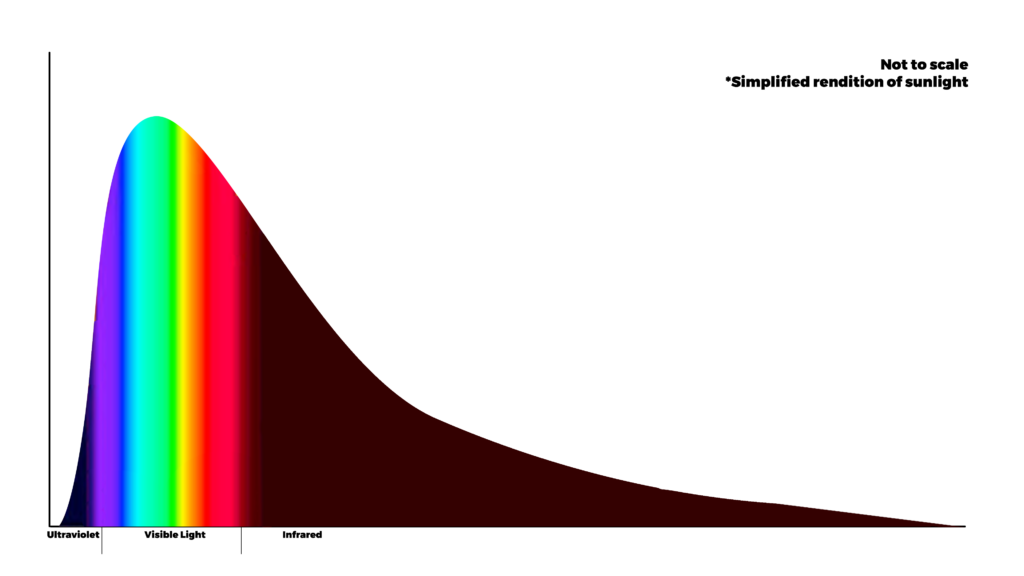
If we take a look at an image of the rainbow of the suns spectrum from Ultraviolet to Infrared, you can see that the sun emits this whole range of colours – it emits these pretty consistently in the full range.
Now if I show you what light the Mercury Vapour Lamp emits, you can quickly see that it’s just….not the same!

These lines are the mercury ’emission lines’, the only light that the lamp can properly emit. You can see that technically speaking, it does emit some UV, some Visible Light, and some Infrared. But, it is NOTHING like sunlight.
We find that these lamps have a really low colour rendering index for humans – often less than 40/100. And you don’t need a special machine to tell you that – just look at the weird green colour it puts off. Does that look like sunlight to you?
And what about that reptile that has tetrachromatic vision, or that marmoset – a group of animals in which the males and females have different colour vision from one another? What on earth are they seeing from this thing?
The truth is, we don’t know. But what we DO know is that it’s not like full spectrum light.
And I know that these lamps have been used for many many years, especially in reptile keeping. They saved the lives of so many reptiles back in the day, because that small amount of UVB that they emit was just enough to scrape through and protect them from metabolic bone disease. But we do have better options today.
The fact that the colour is funky is just one reason not to ‘love’ these lamps. There’s actually some other reasons that are a bit more serious.
On some videos online you’ll see people using a solarmeter to ‘test’ their mercury vapour lamps. They’ll claim that the higher number means that the lamps are a higher quality.
What the people in these videos completely fail to mention is that the solarmeter doesn’t measure the quality of light at all… it measures UVI. And UVI is just an index of how much sunburn-causing radiation there is. You can get a really high UVI reading from a UVC sterilisation lamp, but that doesn’t mean it’s a good lamp for a reptile!
I’ve properly tested these types of lamps under controlled conditions with spectrometers in many shapes and forms, including lamps claiming to be specially designed for certain voltages. And the following rings true for them all: you pose a serious risk of under- or over-exposing your animal to UV when using these lamps.
It’s true that all lamps have a risk, but it’s so much greater in mercury vapour lamps given that the UVB can’t be controlled independent of the infrared.
If you want to expose your animal to a set level, say UVI 3, then you need to have the lamp a set distance away. But that distance may be too close, or too far away, for the appropriate basking radiation.
And equally, if you base the positioning on safe basking radiation, you could end up exposing your animal to too much or not enough UVB.
And to put into perspective just how dangerous it is, if you get these lamps too close you really do expose your animal to ridiculous levels of UVB, as well as unnaturally short-wavelength UVB and even UVC in some cases.
I can’t even begin to say the amount of times I’ve seen animals being kept directly under these lamps – where the animal is certainly being exposed to those dangerous wavelengths.
Let me be clear on what I’m saying – all lamps can be extremely dangerous if used incorrectly, but the risks are much higher with Mercury Vapour Bulbs.
As I say, I’ve tested these lamps from a whole host of brands and it’s clear from those tests as well as tests from other professionals that these lamps simply don’t have a consistent build quality. Two lamps from the exact same manufacturer, in the same batch, can have two totally different outputs. And that’s a recipe for disaster as it makes it really difficult to advise how far away to have the lamp to achieve a certain result.
Not only that, the output changes very dramatically over a very short time. I’ve seen lamps emitting a UVI of over 50 at their recommended distances, and then the next day at the same distance only emitting a UVI closer to 2!
Sure, they seem easy enough. Screw it in and off you go, but there’s just so much that can go wrong, you could accidentally cook your animal with the heat of the lamp or accidentally be exposing them to harsh short-wavelength UVB which is damaging to eyes and skin.
And then to pair that risk with a spectrum that isn’t anything like the sun – it feels like the ONLY reason to use these lamps is for the benefit of the keeper and not the benefit of the animal.
I do want to go through some of the most common things we see said about them…
They’re useful in some settings
Of course, there will always be people who say that they’re useful. And those people aren’t necessarily wrong. If you have the means to measure your UVI, and you use an independently proven safe Mercury Vapour Lamp as a supplement to your existing full-spectrum setup then it can be made to work. But that’s very different from using one on its own, and very different from using one from a questionable amazon seller.
I’ve used them for years with no problems
This is a classic argument we see across the range of old-fashioned husbandry techniques. From keeping bearded dragons in 40gallon tanks to feeding tomatoes to hermanns tortoises – people use the same excuse that it was fine in the past and so should be fine now. And they often refuse to accept modern understanding of animal care and the fact that things may have changed. Let me put it this way, Mercury Vapour Bulbs remain pretty much unchanged from over 30 years ago. Do you still use the same TV you had 30 years ago, the same phone you used 30 years ago, the same computer you had 30 years ago? Why use the same UVB bulb that you had 30 years ago, then?
If they’re so bad, why do the brands keep making them?
Even highly respected brands like Zoo Med and Arcadia have these products. Arcadia actually brought a new one out not long ago. And… it’s about money.
This is one of those catch22 problems. People are going to buy these lamps until they know otherwise. And if Arcadia stopped selling them for example, those customers would just move to another brand. That doesn’t look good on the annual sales figures…
The brands either all need to agree to stop (or be forced to by legislation), or none of them will stop.
You could say the same thing about red or coloured lamps, which all the brands still insist on selling. Or the insistence on advertising Heat Projectors as basking lamps or saying halogens are UVA lamps – both of which are problems in their own ways.
Bottom line, just because a company releases a product doesn’t mean it’s definitely suitable.
I know my animal best, and I give them the best. They are happy.
Again, this is the same sort of defence we see for poor husbandry all over animal keeping. It gets kind of boring when you’ve heard it so much.
You COULD ask what metrics people are using, whether they are basing their idea of good welfare on agreed scientific standards, the 5 Domains, or any blood results. After all, Extraordinary Claims require Extraordinary Evidence.
But that generally just makes people angry or defensive. There is no argument here, these people tend to have already made up their mind and it’s a real shame.
I just implore people to check in with the science and check independent test results like the ones I’ve posted on the website.
I use these and my vet said he’s healthy and that this light is the best
There is no veterinary college in the world that I’m aware of that has a specialised animal lighting courses. Vets are trained in medicine and anatomy. They are absolutely fantastic doctors. And that’s what they are: doctors. They aren’t lighting specialists, or even husbandry specialists.
I actually run CPD for vets on lighting and husbandry matters, and work with vets up and down the country as a referral point for these things.
Stick with your vet for veterinary matters – that way you’re getting the most out of them.
Smart people know their limitations. And good vets will be honest about the fact that their knowledge of lighting is limited.
Then what SHOULD I use?
This is actually a good question, or at least the start of one. This is the sort of question people should ask themselves at the very start of lighting their exotic animal – ideally before making any purchases.
If you remember back to the very start of this article, I mentioned the sun and all the benefits. Well, it’s all of those benefits that we want to replicate. So, we need lamps that specialise in providing benefits from different parts of the spectrum. The R&D that goes into modern phosphor blends on specialised UVBs lamps for example is immense – that’s me speaking from experience.
There’s some super high quality LEDs that are designed specifically for animal vision and not human vision, and we have dedicated sources of basking radiation sold just for animals. Stick those together and you can get a pretty good replication of sunlight in your own home.
But, as with everything, there isn’t a one-size fits all answer. The lamps YOU should use will depend on your species, the size of your enclosure, the distance between the animals and the lamps, whereabouts you are in the world, and many other factors.
This is why it’s so vital to provide this information when asking what lamps are suitable for your animals. If you’ve asked “what should I use” without any clarity on your setup and someone has answered with a link to a specific lamp – I wouldn’t follow that advice.