

The content in this article including, but not limited to, the text, graphics, images, links, and other materials is for informational purposes only. The content is not intended to be a substitute for professional legal or compliance advice. No commercial competition, comparative advertising, or brand discrediting is intended. This article does not assert or imply misconduct or wrongdoing by any party. Neither this article, Tomaskas Ltd, or the author intend to defamate or harm the reputation of any manufacturer, individual, company, or brand mentioned herein. Conclusions are made based on own-collected evidence and understanding of the relevant regulation. Evidence is provided so that the reader can make their own conclusions. Correct at time of publish.
If you’ve got a lamp box lying around (and we’re sure you have), go ahead and pick it up. What’s the first thing you notice? More than likely, it’s the branding – the logo, imagery, and product description. Maybe you’re more concerned about the output specifications or the spectral graph – the colour temperature and the lumens per watt.
How about the regulatory symbols?
We know, we’ve probably lost you already, but stick with us. These miniature marks tell us a lot more than whether you can recycle the packaging or not. They’re a great indicator for how much a brand cares about their craft – and whether you should trust them with the lives of your animals.
It can get confusing with different legislations, regulations, directives, and code names. As a really quick overview, here’s some terminology and what it means:
Regulation – a law. It must be followed letter by letter by all participating countries.
Directive – a set of rules that should be interpreted under local laws relating to the participating country.
Decision – a confirmation or added clarity on a specific part of a Regulation or Directive
International/Harmonised Standard – an agreed minimum, which is agreed internationally.
Localised Standard – an agreed minimum, usually an adapted version of a harmonised standard.
With that in mind, there’s ways to tell if a product has met the standards, and kept within the regulations and directives, by checking the regulatory markings. First, let’s delve into what some of these marks mean, and why they’re so important.
Let’s try to break it down. The first three marks we’re going to explore are CE, UKCA, and WEEE. They look like this:
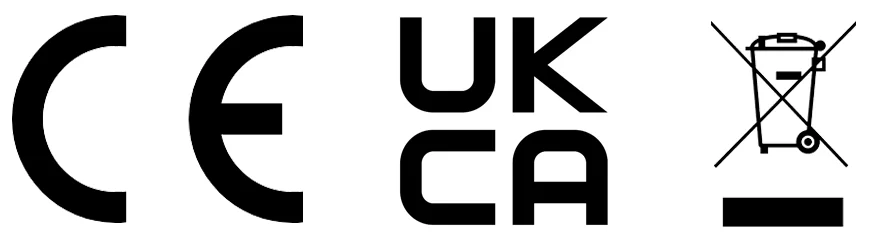
CE
A CE marking is probably the one you’ll be most familiar with. It indicates that the product complies with the relevant EU legislation and may be sold anywhere in the European Economic Area (EEA). For electrical items like lamps, this includes complying with the Low Voltage Directive (LVD) and Electromagnetic Compatibility Directive (EMCD).
LVD – covers health and safety risks on electrical equipment operating with an input or output voltage between 50–1000V for alternating current and 75–1500V for direct current.
EMCD – ensures electrical equipment doesn’t emit excessive electromagnetic interference (EMI) that may disrupt other devices, whilst having enough immunity to function properly.
UKCA
UKCA (UK Conformity Assessed) was intended to replace the CE marking from 2022 for products sold in Great Britain (England, Scotland and Wales). Originally, all manufacturers had until the end of 2024 to retrospectively add the UKCA mark to their existing products and were expected to use UKCA marking on all products entering the UK market going forward.
However, just before the deadline, the UK government withdrew the requirement and announced that whilst UKCA was still accepted, the use of CE was still allowed. Since UKCA doesn’t apply to Northern Ireland or EEA markets, most manufacturers and suppliers prefer to stick with CE as it covers all bases.
UKCA can essentially, for most cases, be seen as the UK equivalent to CE.
WEEE
This stands for Waste Electrical and Electronic Equipment, which refers to any discarded electrical item with a plug, cable, or battery – like a lamp or thermostat – which needs proper recycling in order to protect the environment.
For the average consumer, this usually means sending or taking it to an appropriate recycling facility to it can be disposed of safely and responsibly. It’s essentially a symbol telling consumers not to throw away electrical items with the normal waste.
In the UK, there’s different requirements and systems in place for those who are “Producers” (aka, the brands or manufacturers), and those who are “Distributors” (aka, the stores).
Producers have to report to government how much electrical waste they are putting on the market each year, and pay a fee to fund the recycling system in the UK.
Distributors in the UK have to offer written advice to customers about the electrical waste and how to recycle it. They must also offer a “take-back” scheme, in which they must accept electrical waste for free, and retain a record of all the waste they have taken back within 4 years.
Design requirements and placement
Still holding that lamp box? Take a look at the symbols again, now that you’re a little more familiar with them. Grab another box from a different brand and compare them. Notice any differences? Well, you shouldn’t. Regulatory symbols have strict design and placement requirements that need to be followed. In general, the marking should be visible, legible, and permanent – but there are specific rules for each one.
For the CE mark, for example:
- Both letters must have the same vertical dimension
- The marking must not be smaller than 5mm
- If resized, the proportions of the letters must be preserved
- It must be affixed directly on the product
This is actually written into law, in Regulation (EC) No 765/2008. That’s a Regulation, a law, dedicated to how to use the CE mark. There’s even an example of the exact proportions to use included in the appendix.
There’s also examples on the other markings too, like the WEEE symbol. This symbol is covered by a Directive, specifically Directive (EU) 2024/884 (An update of Directive 2012/19/EU) – and the design is an agreed standard called EN 50419. You might notice the black line under the crossed-out bin symbol, even this is covered in the Directive! And there are direct requirements for the size of this symbol too.
When symbols are used
The symbols are supposed to be used when a manufacturer has confirmed that they have met the requirements under the specific Directives relating to their product (for example, the EMCD and LVD for a typical lamp).
Alongside the symbol on the product itself, and kept filed by the manufacturer, is a document called a “Declaration of Conformity”, which details why they are using the mark on their product in the first place and what Regulations and Directives they are specifically covering with the mark.
This Declaration of Conformity is signed by the company to confirm that they take full responsibility for their compliance with the Regulations and relevant Directives, and that they have ensured that the product has met the requirements have been met. This is a regulatory requirement.
So, in order to use the CE mark on a lamp for example, the manufacturer must also have declared that they are solely responsible for ensuring conformity to relevant requirements to EMCD and LVD, as well as any other relevant Directives.
Are compliance with CE (LVD and EMC) essential?
In order for a lamp to be sold in the EU and UK, yes. There is no way around this.
If a product isn’t compliant, then it is possibly not safe to the relevant localised or international standard. It could be a fire risk, a cancer risk, an electric shock risk, or interfere with other products in a way to make them dangerous.
No insurer will indemnify damage caused by a non-compliant product.
It’s quite simply not worth the risk of putting a non-compliant product near your animals or in your home.
Can a product be compliant but have the wrong mark or no mark at all?
Most of the time, no.
In order to be compliant with the relevant Regulation or Directive, the manufacturer signs the Declaration of Conformity which confirms that they are solely responsible for remaining compliant. When ensuring compliance, the manufacturer must have the product tested to certain international or localised standards.
For example, in order for a lamp to be compliant, it should be able to meet to a Harmonised Standard called “IEC 55015”, as well as many others. And it is up to the manufacturer to ensure they meet with this standard and thus are compliant with the Directive or Regulation. This can be done with laboratory testing.
Part of the remit for some of those standards is ensuring that the marking itself is correct. This means if the mark isn’t correct then the item doesn’t meet the standard, and isn’t compliant. It means it’s likely not been tested for safety. It’s as simple as that.
There are exceptions in special cases, but these are regarding items that are tiny, smaller than 5mm tall, and certain explosives. These exceptions don’t apply to animal products.
Is compliance with WEEE essential?
Again, yes.
All retailers of electrical items must, by law, give written advice to customers about their services regarding waste electrical items. This is usually a sign up on the wall at the checkout of a store, but sometimes it’s provided in leaflets or on receipts.
The brands must pay to be a registered producer in the UK. And they must inform customers about disposing of their products safely and recycling where possible.
Okay, but why is all of this important?
Compliant labels like the ones we’ve discussed are essential for maintaining product safety. They offer reassurance that the product meets high environmental standards and complies with UK and EU regulations. In other words, it’s a way of letting consumers like us know that the products we’re picking up from the shelves (or adding to our online basket) are safe for our animals.
Labelling a product incorrectly (or not at all) can lead to fines, recalls, and bans… but the sad truth is that many of them simply fall under the radar. This is why it’s so important for all of us to be informed about what the brands should be doing, so that we’re able to call them out when they’re not.
Think about it: if we can’t trust a brand to follow mandatory health and safety regulations, how can we possibly trust them with the safety of our animals?
If they can’t get the symbols right – something they are legislated to do – why would they bother getting the spectrum right? Why would they bother sourcing safe electronic components? What other corners would they cut?
What do I do?
If you’re in the UK and you have a product that is non-compliant, refer it immediately to your local Trading Standards Office or equivalent. More information can be found here: https://www.gov.uk/guidance/consumer-products-reporting-product-safety-issues
You can also get in touch, and see if Tomaskas can help. In some cases, we may advise that you don’t contact the manufacturer and instead you send the item to us where we will refund you the cost and keep the item on hand as evidence for a larger investigation.