
On 14 January 2026, Tomaskas received a notification urging the removal of a report that was posted at the end of 2025.
The report was in relation to a UVB LED product from a brand called “Bo Lights”.
In the report, we essentially concluded that we’re suspicious of some of the compliance marking on the product, as well as the readings we collected on the product. On 14 January 2026, after receiving the letter, we took another look at the data and our findings. And we found another problem that was confusing and potentially upsetting – and we updated the report accordingly based on the new information.
The new discovery made us giggle, but was also quite shocking: The information and safety booklet included with the lamps invited customers to visit a website featuring explicit pornography. Yes, you read that right: the product invites customers to go to a porn website.
You can read the new report here.
That, to us, screams a lack of quality control. It is mind blowing how a company can be expected to produce safe and suitable lighting products for animals under human care when they can’t even check their own documentation.
The letter we received appeared to mis-spell the name of their own company: “Bo Compagny” [sic]. We thought this was ironic, and again indicative of what we were dealing with. They alleged that Tomaskas made claims without evidence, forgetting that Tomaskas is a consultancy with dedicated work in the world of compliance to harmonised standards. We’ve seen this hundreds of times, and we know what we’re looking at.
There was a sense of urgency in the letter we received, and an insistence that the findings were incorrect. Bo Lights threatened that if we didn’t remove the report within 48 hours, and confirm in writing that it was completed, then we’d be taken to court and charged €1000 a day.
That sounds a lot like an attempt to cover up a problem. Rather than engaging with the findings, and opening a dialogue to work on improving the products, Bo Lights doubled down on their insistence that their product is safe and compliant, and that they uphold high quality control.
We didn’t believe them. We were certain the lamps would be non-compliant. And to prove it, we had the products tested to the standards that we thought would fail. The tests were conducted in an ISO 17025-accredited facility, to the harmonised standards, under controlled conditions.
Guess what? The products failed the test.
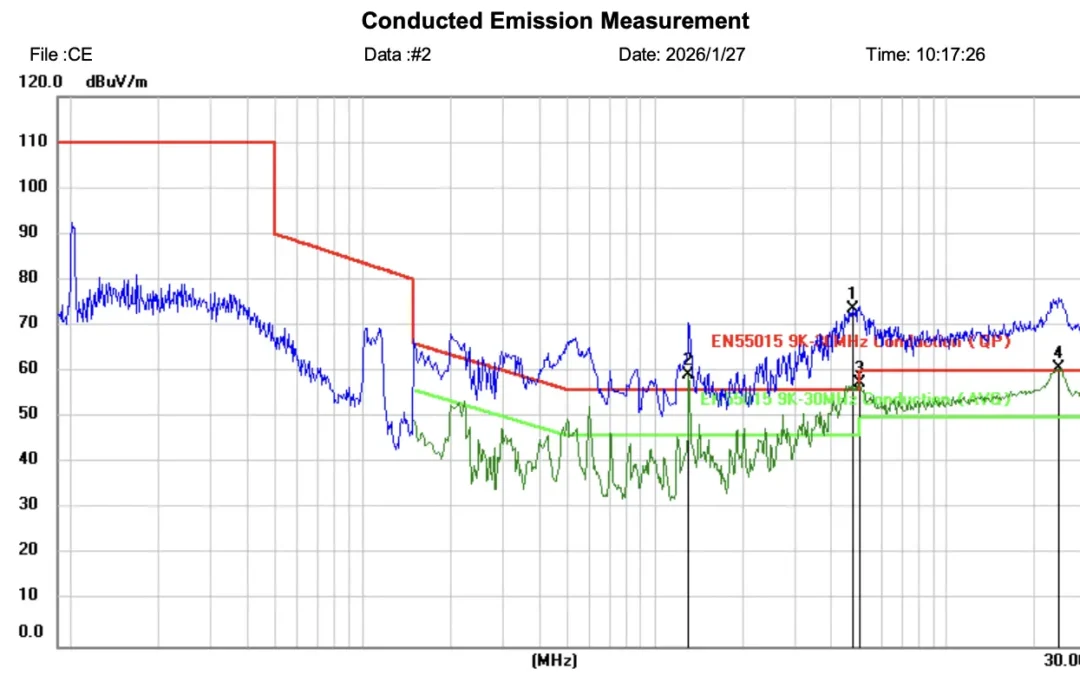
The products we tested do not pass EN 55015 (EMC) testing just as we had presumed. Based on failure of testing to EN 55015, it would make any use of the CE mark and UKCA mark on these products (which are under scope of EMC) outright incorrect and potentially illegal.
This is a huge red flag.
Why on earth would you want to put something over your animals that is non-compliant with basic electronic standards? There’s serious risk of electrical issues if using a product that doesn’t meet basic compliance standards.
We have reached out to Bo Lights for comment on the following:
- The link to porn featuring in the information booklet.
- The failure of [BS] EN 55015.
- The CE marking appearing to not comply with Regulation (EC) No 765/200.
- The UKCA mark being present, without a UK plug included.
What EN 55015 failure means
EN 55015 is the standard used when testing products like these to compliance with EMC Directive 2014/30/EU. The lamps fall under scope of needing to meet the standard in order to be in compliance.
Failing to meet EN 55015 means that the product either conducts or radiates electromagnetic disturbances that can affect other appliances in a way that causes unintended operation, and potentially dangerous situations. In this case, the testing shows that the unit failed on both conduction and radiation.
Failure also means that the tested product should not bear the CE or UKCA mark, and any use of such marks is potentially illegal.
Funding these tests
A portion of the lamp testing is done out of our own pocket. Whilst Tomaskas is often paid to conduct private consultation to a range of manufacturers, many of these reports are private. The tests in this case were funded privately, and not by any of the companies mentioned.
This funding comes from a range of sources, including personal expenses, company expenses, and the kind donations of others. If you’d like to donate to the “lamp testing” fund, to help us get more lamps in for testing, then you can do so by going to www.tomaskas.co.uk/donate.
Tomaskas Ltd. is not a charity or NPO, and does not rely on donations to stay afloat. However, donations are greatly appreciated and help cover the costs of purchasing products for testing, electricity for lamp testing, and much needed coffee to keep us working!
You can make an anonymous donation, or a public one. There is no obligation to donate, as information will remain freely available for all.
The Data
Key — * : Maximum Data — X : Over Limit (Fail) — ! : Over Margin (Fail)


