

Why you can’t trust what you see online.
We often find that new and experienced keepers alike will head to google, do a quick search, and call that research.
I’m guilty of this myself – after finding that my toilet wasn’t flushing properly I went straight to google and found a single blog post along with a 5 minute youtube video on how to fix a toilet flush. That was it, as far as I was concerned I was a fully qualified plumber. And oh, how I was wrong. I sort of botched together a fix, and my toilet worked – sort of. But it wasn’t a professional job. A few weeks later I was left with pie on my face as I had to call in a professional to fix the problem.
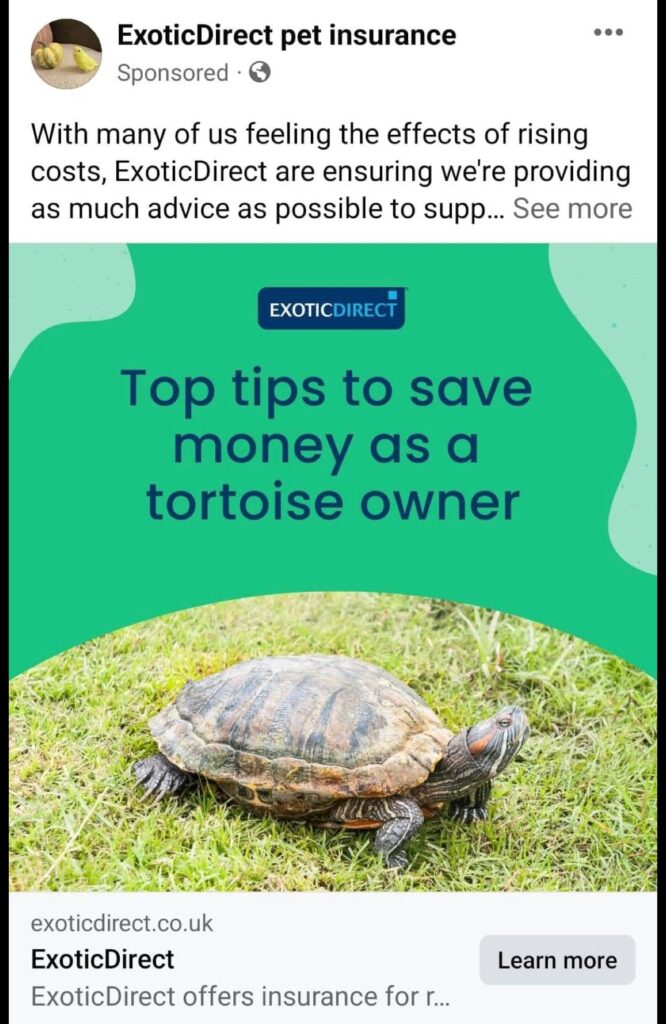
This kind of thing happens all the time – especially with animal care. But, more often than not, articles online have not been written by a specialist. Yesterday I was made aware of a poorly written article on a popular website from a very popular exotic animal insurer – Exotic Direct.
Exotic Direct is a trading name of Brooks Braithwaite (Sussex) Ltd., and is a part of the Many Group Ltd family (formally known as BoughtByMany). Exotic Direct is considered a specialist insurer – focusing on just exotic animals. They are the sort of company that many pet owners rely on when it comes to financially supporting them in times of need. Because of this, it can be presumed that many people count on them as a reliable source of information for their animal’s health.
The article was entitled “Quick and easy ways to save money as a tortoise owner.” and was written by Rachael Smedley – someone who works for the marketing department at Many Group. The Marketing Department…
The article itself was riddled with problems – it spoke of feeding fruit to your tortoise (without any mention of species-specific diet), and featured an image of a Red Eared Slider (Trachemys scripta elegans) – an animal that for all intents and purposes is illegal in the UK. All whilst using the words “without cutting corners and putting their pet’s health at risk” in the article.
I contacted the company to make them aware of their problems, and introduced myself. I offered to help them going forward, without any mention of charging them for the service.
Unfortunately, Exotic Direct have failed to respond to my email. They have made some small changes to the article, and it is now much more acceptable (besides using the word “breed” which is a pet peeve!). The fact that they have made changes to the article indicates to me that they’ve definitely seen my email.
This single example is indicative of the problem of conducting “online research”, and the poor quality of information out there. The information you read online is often written by a marketing team, a blogger, or other entity without any references to scientific papers or journals. Such writers often do not have any relevant qualifications or enough experience to be offering care advice.
I’m trying my best not to go through every single article on the Exotic Direct website to check for blatant misinformation and bad advice.
This is a reminder to be very careful with reading articles online. Even websites like Exotic Direct that are “backed by vets”.
I’ll leave you with an image of what Exotic Direct thinks is a tortoise, and should be fed fruit…
This article is designed to be read in it’s entirety. If you wish to provide a quotation from this article anywhere else, you must share a link to the entire article along with a statement such as “to get all of the details, please read the article in full”. Please refrain from posting select sections of the article, as this could give a false representation of the independent and honest information provided.