
There is a video version of this post, available HERE.
The embedded version is here:
I want to talk to you today about Metal Halide lights. Lighting with animals, especially reptiles, is a really big topic and I’ve been asked plenty of times to do videos or blog posts on it (and a whole video or blog series in fact).
And the thing is, it’d be a massive task – I’d have to start at Square One and make my way into more and more intricate theories and practices as the videos or posts progressed. And if we did do that this post you’re reading now would probably be number 237 in the series!
So, we’re not doing that – at least not yet.
So we go into this post with some basic agreements first:
- the first is that I’m going to talk about Concepts like UVI, UVB, UVA1 and UVA2, Lux – and I’m going to presume that you have a base understanding of what those different things mean.
- I’m going to talk about the Solarmeters a little bit, and again I’m going to presume you know what the differences are between them.
- I’m going to refer to the spectrum of lamps, again I’m going to presume you know what that means
- And, I’m going to use the word lamp quite a few times in this now for anyone who’s in America or Canada you may prefer to use the word “bulb” when you talk about something like this, but technically it’s a lamp so I’m going to refer to it as a lamp in this post.
- And finally, I will be referring to my personal definition of ‘full spectrum’. I’m not going to be referring to the definition used by some companies when they’re advertising LEDs or fluorescent lamps.
There’s certainly some concepts in this post that aren’t going to be necessarily friendly to beginners, but I’m going to try my best to make things make sense for you!
It’s my honest opinion that animals in captivity are chronically underlit, especially reptiles. It’s not uncommon for a pet shop to sell a Bearded Dragon (something that comes from the Desert) with a heat lamp and a T5 UVB system and then call it a day.
But actually, if we measure the lux in the basking area for that enclosure what you’d probably find is maybe 4,000-5,000lx maximum. Whereas if we go to the Australian Outback, where these animals are from, you may find 120,000-130,000 lux! That’s a heck of a lot different!
And that light has a whole host of biological benefits. We’re talking things like hormone release, metabolism effects, gene upregulation, and so much more. That extra light is really valuable in the enclosure. And one way to brighten up an enclosure would be to use a Metal Halide lamp.
I get asked a lot of questions about Metal Halide lamps and I see questions a lot posted on Facebook, Subreddits, WhatsApp groups, Discord Servers, you name it. And I wan to think that this has something to do with the amount of times I’ve mentioned them on videos with Reptiles & Research and Animals at Home for example.
Now I’m not blowing my own trumpet here, what I’m saying is with tens of thousands of views on those videos is it any surprise that a few more people want to know a little bit more about these lamps?
But what even is a Metal Halide lamp?
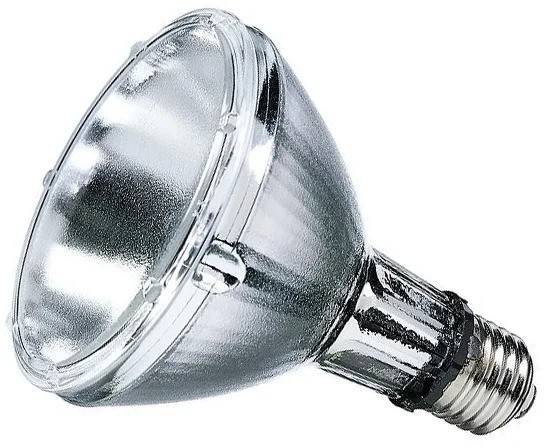
Without going into a history lesson, (this technology has been around for a long time!) it essentially evolves a little tube inside a lamp body (or envelope) and in the little tube are a lot of different chemicals (called Metal Halide Salts). When you energize those metals they Vaporise and emit light.
If you’ve kept reptiles before you’ve probably seen a Mercury Vapour Bulb before – now this works in a very similar way. They have a little tube inside called an arc tube and inside that tube is Mercury which is a metal.
Similar lamps exist such as Sodium lamps – which is what those old street lights are! They had the really orange glow.
Well, get a mixture of different metals and pass a high intensity electrical arc through them and they will all vaporise and mix together and they make white light. It’s actually that high intensity arc that gives it the common name High Intensity Discharge lamp – HID (you may see them called HID online).
Another name you see is “HQI”, which is actually a trademark Osram. For the sake of this post, HQI, HID, and Halide are all the same thing. And they come in a range of wattages and sizes. In fact some of them even emit UVB – really useful for reptiles! In Europe, they’re super popular.
For some reason, they never really made it quite as big in the UK or indeed in the US or Canada. I think that’s something to do with some of the things we’re going to talk about today in this post.
Why use one of these lamps in the first place?
That’s a great question, but I will say they aren’t for everyone. The primary reason they’re used is the absolute fantastic spectrum that they can give off (not all of them do). The good ones are so bright and have such a good quality spectrum that they can fulfil a role in an enclosure that no other lamp can.
I personally use HIDs in most of my encloses (where it’s reasonably possible) and my experience in working with them in a professional setting as well as in my personal setting I find that animals really respond well. Uromastyx, Bearded Dragons, Cyclora, all really love the light that HIDs give off. In fact I’ve seen animals follow the lamp around the enclosure when we move it around because they prefer to bask under it than other lamp sources. Heck, I’ve even seen snails bask under them!
Is it an economical option?
It depends on how you look at it. The ones I usually recommend for ‘home use’ (rather than zoo use) tend to come in three main wattages: 35W, 50W, and 70W. And normally I’ll go recommending a lamp that has a screw base (E27 or E26).
At 70 Watts, for example, you’ll be consuming 70 Watts of electricity – and that 70 Watts has to go somewhere. They emit a lot of visible light, but these lamps do get hot – and using one alongside say a 75W heat lamp and a 24W T5 UVB system, you can quite quickly rack up a high energy bill (that’s speaking from experience!)
Compare that to a nice bright LED which can use as little as 25W, it’s easy to see why an LED may be preferred but I think the spectrum is what makes a HID better in many cases.
So what is the spectrum like?
On the good lamps it’s shockingly good.
Here is a typical white LED:
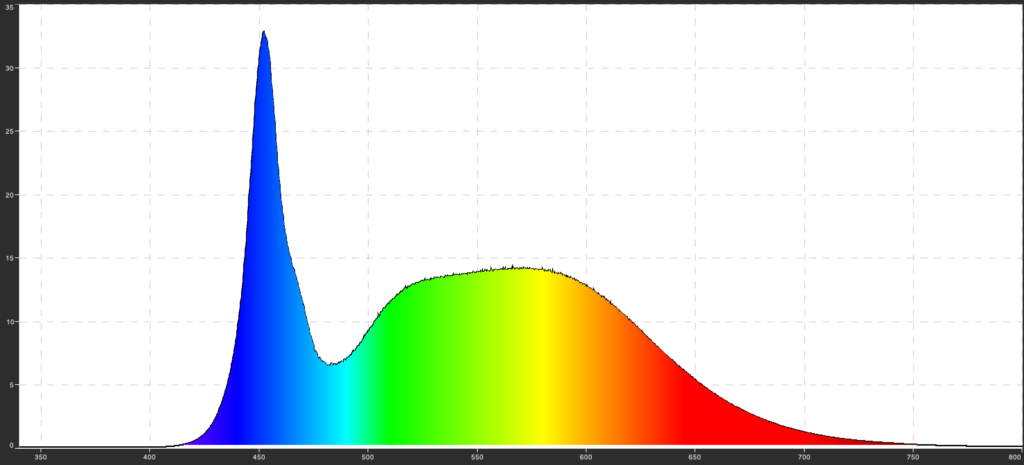
You can see that there is no UVA emitted. There is no Violet emitted. There is very little to any red emitted. In fact, the colour rendering of these lamps tends to be pretty low.
Compare that to a high quality HID:
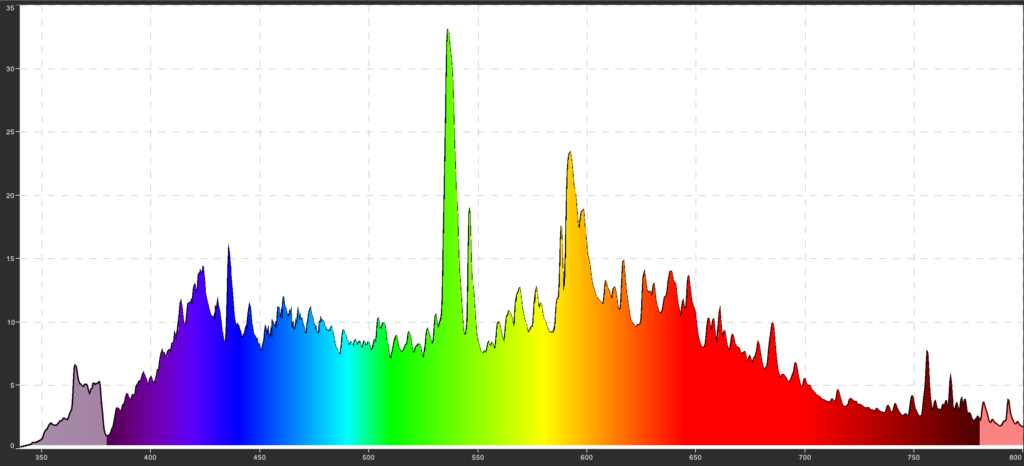
You get an amazing sunlike proportion of UVA1 to visible light.
It’s really something that nothing else can do – and this is super bright light that lasts for years and years.
Is it easy to set up a Halide?
Compared to an LED, a HID isn’t really as simple to set up. For starters, you can’t just plug it in and go.
A HID requires something called a ballast to make it work. If you’ve used a fluorescent UVB system, you’ve used a ballast before. With the T5s, the ballast is rated for the wattage of the lamp that you need to use. So if you want to use a 24W T5 you need a 24W ballast – it’s the same thing for metal halide: if you want to use a 35W metal halide lamp you’re going to need a 35W ballast. There are even some ballasts that have wattages that can be changed for example there one from the brand Mega Ray which allows you to change the wattage from 35W to 50W to 70W. This allows you to use the three most popular types of lamp.
Rather than plugging straight into the wall, you plug the ceramic fixture into the ballast and then the ballast into the wall.
What’s the actual cost?
Buying a ballast costs money in – fact the Mega Ray one costs about £90 in the UK then if you want to plug that into a dome fixture (which you need to buy!) you may need to wire it in. If you’re not comfortable doing this, you may need to pay someone else to do that which is an additional cost.
Then the lamp itself which can cost say £50, so you can see how quite quickly you rack up a cost. It’s not unheard of to have a £150 startup cost vs say £50 for an LED. Not to mention that if you’re using a UVB-emitting HID lamp you may need to replace it on a regular basis (12 months) so there’s an annual cost too.
For me, the higher cost is worth it considering the spectrum.
In terms of running the lamp, you can use an online calculator like this one to help you calculate these costs.
HIDs aren’t cheap, and they aren’t something you can try and cheap-out on either by getting no-name versions but to be honest that’s reptile lighting! Much of the time you get what you pay for!
What happens when they turn on?
It’s not abnormal for a HID to flicker when it is turning on. This can happen for 10-15 minutes whilst the lamp ‘warms up’ and all those metal salts vaporise in sequence.
The ballast can also make a buzzing sound during this time, which is absolutely normal.
Compared to an LED, which turns on instantly, it’s certainly different.
If turning on a UVB-emitting halide, you may also be able to measure the UVI changing dramatically over the first 15 minutes. This is normal.
Would a Halide be suitable for my XYZ animal?
Most of the time, the answer is yes.
It’s less about the animal, as there’s probably a halide for everyone. It’s more about the setup.
It’s just like any other lamp, you wouldn’t use for example a 54W 12% T5HO lamp 10cm away from a Leopard Gecko. And you wouldn’t use a small 25W heat lamp 200cm away from a uromastyx. The same rules apply to Halides – you need to find the right wattage and the right distance for the right species.
The UVB-emitting lamps should come with recommendations for how far away to have them from example animals. And you can use a solarmeter to refine your distances as you progress.
How long do Halides last?
They will all emit visible light for years (if you look after them properly!).
For UVB-emitting lamps, it is best practice to also monitor the decay of the UVB, which usually happens over 6-12 months.
There are certainly things you can do to look after your lamp:
- Don’t plug into a thermostat.
- The first time you turn it on, leave it turned on for a full hour to ‘bed in’.
- Try to only cycle the lamp once a day.
- If you DO need to turn it off, wait 15 minutes before turning it back on again.
- Try to allow airflow to keep the lamp as cool as possible.
- Don’t be fooled by wattage, and don’t mix up wattages.
They do sound like a lot of work!
Yeah, they’re not super easy. And that’s probably the biggest reason why people don’t want get them.
If I were to summarize and make a ‘for’ argument and an ‘against’ argument I think the ‘for argument’ would be that they have this fantastic spectrum, and the ‘against argument’ would be that they’re just a little bit more difficult to set up than other lamps.
But, really, I think the effort is worth it for the spectrum that you get out Halides. I think it’s worth putting in that little bit extra effort. And surely what we want to do: find joy in creating a perfect enclosure for our animals – a perfect home within our own home. And that little bit of extra effort can make it all the better.
I’m advocate for good lighting, and I genuinely think that HIDs can provide something that no other lamp that we have available can provide. But I do think that anyone wanting to use them needs to research them properly.